

SMSF Property Loans in 2026: What Changed on 10 August and What You Can Still Do
SMSF Property Loans in 2026: What Changed on 10 August and What Your Fund Can Still Do
On this page ▾
Your SMSF can still own property, but a new SMSF loan entered into on or after 10 August 2026 can no longer be used to buy an ordinary residential property. That is the law, not a lender preference: a new limited recourse borrowing arrangement over real property must now be for business real property. Loans already in place, their refinancing, and purchases under a contract the fund exchanged before 10 August all carry on.
So the useful questions have changed. If your fund already has a loan, can it move to a sharper one? If you run a business, can the fund still borrow for the premises? If you signed a contract in early August, is your purchase safe? This guide answers those, from the lending side.
One scope note first. As mortgage brokers we arrange the credit, which means the loan itself. Whether property belongs in your fund, and the tax outcome of holding it there, is a question for your SMSF accountant or a licensed financial adviser. Moneysmart’s SMSF property page explains who can give that advice.
What changed on 10 August 2026
The change came in the Treasury Laws Amendment (Tax Reform No. 1) Act 2026. The SMSF borrowing amendment was added in the Senate on 25 June 2026, and the Act received Royal Assent on 26 June 2026. The ATO’s summary of the new LRBA law confirms it applies to arrangements entered into on or after 10 August 2026. The borrowing change is in Schedule 5 of the Act, which commenced on 10 August 2026, the 45th day after Royal Assent.
In plain terms, a limited recourse borrowing arrangement (LRBA) entered into from that date can only be used to buy real property if the property is business real property. The ATO sets out the detail on its changes to limited recourse borrowing arrangements page. Business real property generally means land and buildings used wholly and exclusively in a business, so an ordinary rental house or unit no longer qualifies for a new SMSF loan unless the fund exchanged contracts before 10 August 2026. Nor does any other property that isn’t used wholly and exclusively in a business.
The ATO lists three things the change does not touch:
- LRBAs your fund entered into before 10 August 2026
- refinancing those existing LRBAs
- a binding contract to buy real property that your fund exchanged before 10 August 2026, even if the contract settles or the loan is entered into after that date.
The rule applies whoever the lender is. A bank, a non-bank lender and a related party lending to the fund are all caught the same way.
LRBAs are not banned
You will read “SMSF loan ban” in plenty of headlines. The ATO’s own wording is that LRBAs are not banned. An SMSF can still borrow under an LRBA and maintain an existing one. What changed is the kind of real property a new LRBA can buy.
The law versus the lender cut-offs
This is where a lot of confusion came from. The legal line is 10 August 2026. Lenders drew their own lines earlier, because an application needs time to reach approval. In the weeks before the change, several lenders on our panel stopped taking new residential SMSF pre-approvals in late July or the first week of August. Most also said they would only fund a purchase where the contract was signed and exchanged by 9 August 2026, which matches the legal date rather than running ahead of it.
So when you hear that SMSF residential lending “closed on 31 July” or “closed on 3 August”, that was one lender’s cut-off, not the law. The law’s date is the one that decides whether your fund’s purchase is allowed. A lender’s date only decides whether that lender will fund it.
If your SMSF already has a residential loan
Nothing changes for an existing loan. If your fund entered into an LRBA to buy real property before 10 August 2026, the ATO confirms the property does not need to be business real property. The fund can maintain or refinance that LRBA on or after 10 August.
The ATO treats a refinance as entering into a new loan contract for the same asset, with the same lender or a new one. That is the refinance your fund can still do. Three cautions from the ATO’s rules for entering an LRBA are worth keeping in mind:
- A significant change to the loan’s terms can end the old arrangement and start a new one. Talk to your SMSF accountant before you vary the terms of an existing loan.
- Borrowed money can pay for the costs of the borrowing and for maintaining or repairing the property, but it cannot be used to improve the property.
- The asset held under the loan has to stay the same asset. Improvements paid from the fund’s own cash can be fine, but changing the property into a different kind of asset is not.
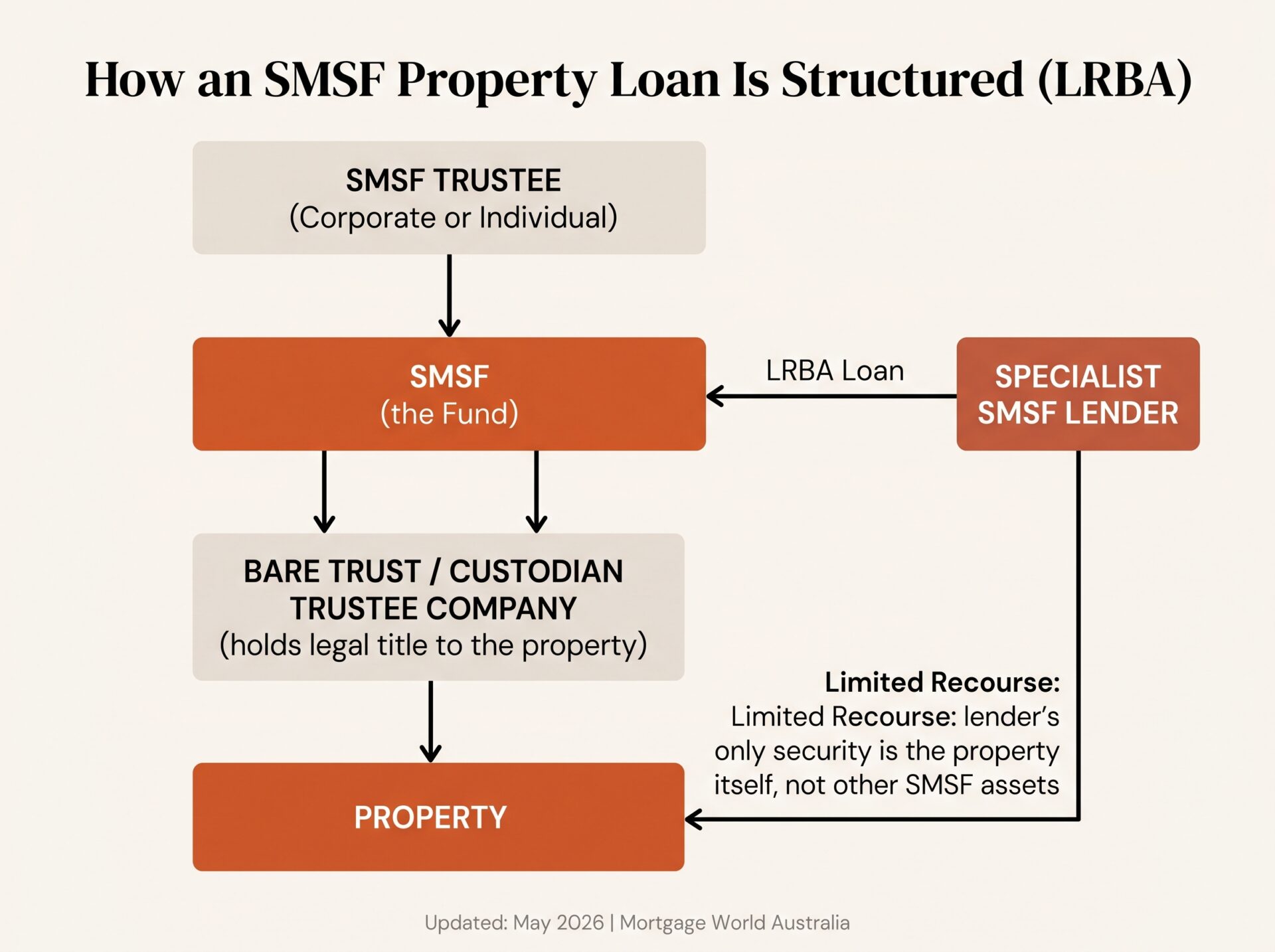
In practice, we structure an SMSF refinance to replace the existing debt on the same property. If you want to borrow more than that, raise it with your accountant before you raise it with us.
Refinancing an existing SMSF loan in 2026
With new residential purchase loans gone, the lenders still in SMSF lending are competing for refinances. That has shown up quickly on our panel. At least three lenders now run streamlined SMSF refinance products. In September, three lenders were also waiving application or settlement fees on residential SMSF refinances, one of them until 12 November 2026.
If your fund’s loan was written a few years ago and hasn’t been reviewed since, it is worth a look. The fund pays the interest, so a lower rate leaves more money in the fund, after allowing for any costs of switching, such as break costs on a fixed rate.
How lenders assess an SMSF refinance
The assessment is on the fund, not on you personally. The fund’s rent and the members’ super contributions have to cover the repayments, with a buffer. Where lenders differ is in how they count each of those.
- Repayment history. Two lenders on our panel will assess some refinances on the fund’s repayment record rather than a full servicing calculation. One uses the last six months of repayments; the other skips the serviceability calculator where the fund can show a good repayment record and the new monthly repayment is lower.
- Rental income. Lenders count a percentage of the rent, not all of it. One lender lifted its SMSF figure from 80% to 95% of rent for loans at 70% LVR or below. LVR is the loan-to-value ratio: the loan divided by the property’s value.
- Contributions. Members’ concessional contributions are the other half of the calculation. They are capped at $32,500 a year per person for 2026-27. One lender counts employed members’ contributions at 12% of base salary. Another counts eligible concessional contributions in servicing.
- The second member. This is the one that surprises trustees. On a recent two-member fund purchase, one lender would only count one member’s contributions, because the other member had returned to work after a break of more than a year. It refused an exception. A second lender counted both members and approved the full amount. Nothing about the fund changed between those two answers, and the same question decides a refinance.
- Money outside the fund. One lender told us in writing that it only needs information inside the fund for its refinance. Another runs a servicing test on a member’s income outside the fund before it will count extra contributions.
- Liquidity. Some lenders want cash left in the fund after settlement. At least one applies no minimum liquidity where the fund already owns a property, and another has no ongoing liquidity requirement below 80% LVR.
Refinance LVRs on residential SMSF loans run to 80% at a number of lenders on our panel.
Documents, valuations and turnaround
An SMSF file has more paper than a personal refinance: fund bank statements, member super statements, the existing loan’s transaction history, the trust deed and the holding (bare) trust deed. The lender’s view of those deeds matters, so we check them before we lodge.
A few lenders have taken friction out of the process. One now accepts the legal advice certificate from the fund’s original loan on an eligible refinance, which removes a fresh appointment from the critical path. Another will accept a desktop valuation on an SMSF loan where its valuation system says one is enough, and has digital loan documents for SMSF files.
Turnaround varies widely. Recent quotes on our panel ranged from a two-day conditional approval target at one lender, to four business days at another, to about 19 days at a third. On a refinance with no settlement deadline that matters less than on a purchase, but it still decides how soon the saving starts.
What SMSF loans cost
SMSF loans are priced above a standard investment loan. Moneysmart notes that SMSF property loans often have higher interest rates and fees than other loans. Pricing is tiered by LVR and loan size, and on our panel commercial SMSF pricing sits above residential.
We don’t quote SMSF rates in this guide because they move with each lender’s rate card and your fund’s LVR. If you’d like to know what your fund’s loan would cost at today’s pricing, send us the loan details and we’ll compare it across the lenders still writing SMSF refinances. A true offset account on an SMSF loan is uncommon, but a few lenders on our panel now offer one.
Commercial property and business real property
Borrowing for business real property is unaffected. An SMSF can still enter a new LRBA to buy real property that is business real property when the loan is entered into, meaning it is already used wholly and exclusively in one or more businesses: an office, a shop, a warehouse or a consulting room in business use. The ATO is explicit that the test applies at the start of the loan and for its whole life, so check with your accountant before the fund buys premises that are vacant, not yet built, or partly used for something else.
Business real property also has two long-standing exceptions in the SMSF rules, both set out in the ATO’s SMSF investment restrictions. Your fund can buy it from a related party at market value, and it can lease it to a related party, such as your own business, at an arm’s length market rent.
A farm can count too. Property used in a primary production business that includes a private dwelling can still be business real property if the dwelling sits on no more than two hectares and the main use of the whole property isn’t private.
The property has to stay business real property for the whole life of a new LRBA. If a leased shop sits empty while you look for a new tenant, it keeps its status. If you give up on leasing it, the ATO says it stops being business real property, and the fund is then in breach of the borrowing rules.
On the lending side, some lenders on our panel go to 80% LVR on commercial SMSF loans, at least one of them with a corporate trustee. One offers an offset account on its commercial SMSF loan at no extra cost, and another has discounted its establishment fee on commercial SMSF loans. For the wider picture on buying premises, see our commercial property loans page.
Contracts exchanged before 10 August 2026
Under the law, the date that counts is when your fund exchanged a binding contract. If that happened before 10 August 2026, the new rules don’t apply, even if finance is approved later and settlement is months away. The ATO’s own example is an off-the-plan contract exchanged before 10 August that settles 12 months later.
Two things can still trip a pre-10 August purchase up.
The first is the contract itself. The ATO says later variations generally won’t matter, but a contract changed so much that its fundamental terms no longer exist may be treated as a new arrangement. Before you agree to any change to the contract, check it with your solicitor and accountant.
The second is the lender. Lenders set their own evidence rules on top of the law:
- One lender now requires every residential SMSF application that isn’t yet conditionally approved to include the fund’s transaction statements showing the deposit was paid before 10 August 2026. Without that evidence, the application doesn’t go to credit.
- Another will accept an application submitted after a policy cut-off where the contract of sale was signed before it.
- One lender said it would not accept deeds of rescission after 10 August.
- Contracts with a finance clause that ran past the cut-off were a known problem, and at least one lender issued guidance on them.
If you exchanged before 10 August and don’t yet have unconditional approval, get the fund’s bank statement showing the deposit, the exchanged contract and the finance clause dates to your broker now.
Can I still buy property with my super?
Yes, but not with a new SMSF loan for a residential property. What’s left:
- Buying with the fund’s own money. The ATO confirms an SMSF can still invest in residential property that isn’t business real property, provided it meets the other rules, but it can’t be financed under an LRBA. The usual SMSF rules still apply. No fund member or related party, which includes your relatives, can live in it or rent it. It also has to meet the sole purpose test of providing retirement benefits. Whether a cash purchase suits your fund is a strategy and tax question for your adviser, not a lending one.
- Business real property with a loan. Covered above.
- Buying outside super. If what you want is a geared residential investment, the loan sits in your own name or another structure, and you are assessed on your own income. Our investment property loans guide walks through that, and the borrowing power calculator gives a first estimate.
- Your first home. If you’re a first home buyer asking about super, the ATO’s First Home Super Saver scheme is a separate scheme with its own rules. It has nothing to do with an SMSF.
- After you retire. Once you meet a condition of release, such as reaching your preservation age and retiring, or turning 65, you can withdraw your super. At that point it is your money to use, including towards a home to live in. The ATO sets out when you can withdraw your super.
How we help with SMSF lending
For a fund with an existing loan, we compare the refinance terms across the lenders on our panel who are still writing SMSF refinances. That means checking how each will count the fund’s rent and each member’s contributions, what liquidity it expects, and whether it will accept the trust deeds you already have. For a business buying premises through its owners’ super, we do the same on the commercial side.
The lender policies in this guide change often, which is why we record them as they arrive. If your fund’s loan hasn’t been reviewed since before August, talk to us about a refinance. The fund-strategy side stays with your accountant or adviser.
Frequently asked questions
Can an SMSF still borrow to buy a residential property?
Generally no. An LRBA entered into on or after 10 August 2026 can only be used to buy real property that is business real property, so an ordinary residential rental no longer qualifies. Two exceptions: a binding contract the fund exchanged before 10 August 2026, and a residential property that genuinely meets the business real property test, such as a farm dwelling on two hectares or less. A fund can still buy residential property with its own money if it meets the other SMSF rules, and loans taken out before 10 August continue.
Is the SMSF residential borrowing change law or lender policy?
It is law. The Treasury Laws Amendment (Tax Reform No. 1) Act 2026 received Royal Assent on 26 June 2026, and the ATO confirms the change applies to arrangements entered into on or after 10 August 2026. Lenders set their own earlier cut-offs for new applications, but those were lender policy on top of the law.
What happens to my existing SMSF loan?
Nothing changes. An LRBA your fund entered into before 10 August 2026 continues as it is, and the property does not need to be business real property. The fund can keep the loan or refinance it.
Can I refinance my SMSF loan after 10 August 2026?
Yes. The ATO confirms refinancing an LRBA entered into before 10 August 2026 is unaffected, and it treats a refinance as a new loan contract for the same asset with the same or a new lender. Several lenders on our panel are actively writing residential SMSF refinances, some with streamlined assessment and fee waivers.
Can an SMSF still borrow to buy commercial property?
Yes, if the property is business real property, meaning land and buildings used wholly and exclusively in a business, both when the loan is entered into and for the whole life of the loan. Your fund can lease it to your own business at a market rent.
What if my SMSF exchanged contracts before 10 August 2026?
Under the law, a binding contract exchanged before 10 August 2026 is outside the new rules, even if it settles later. Your lender may still want proof, and at least one lender now asks for the fund’s transaction statements showing the deposit was paid before 10 August.
What is the 5% SMSF rule?
It is the in-house asset rule. An SMSF’s in-house assets, such as loans to, investments in or leases to related parties, can’t be more than 5% of the market value of the fund’s total assets. Business real property leased to a related party is one of the exceptions.
What are SMSF home loan rates now?
SMSF loans are priced above standard investment loans, with rates tiered by LVR and loan size, and commercial SMSF loans usually priced above residential. With new residential purchase loans closed, lenders are competing for refinances, and several are waiving fees. We compare current pricing for your fund’s loan rather than quote a headline rate.
Patrick O’Brien, Director and Mortgage Broker since 2001.
This article contains general information only and does not constitute financial advice. Your personal financial situation, objectives and needs have not been considered. Before acting on any information, you should consider its appropriateness to your circumstances. Speak to a qualified mortgage broker for advice tailored to your situation. Mortgage World Australia Pty Ltd is a credit representative (CR No. 396946) of Mortgage Specialists Pty Ltd (Australian Credit Licence No. 387025).

Patrick is a Director and a Home Loan Specialist. He has been helping Australians with home loans since 2001. Prior to working as a mortgage broker Patrick was employed by Macquarie Bank for 3 years and also worked as an accountant for a publicly listed company. Patrick’s qualifications include:
Bachelor of Business, UTS Sydney. Majored in accounting and sub-majored in Finance and Marketing.
Diploma of Finance and Mortgage Broking Management FNS50310
Certificate IV in Financial Services (Finance/Mortgage Broking) FNS40804
Ready to Take the Next Step?
Whether you’re looking to buy your first home, refinance, or explore investment opportunities, Mortgage World Australia is here to help.
Fill out the contact form below, and one of our expert mortgage brokers will be in touch shortly to discuss your needs and guide you through your options.
Get Started Today!