
Achieve Your Property Goals Sooner with a Guarantor Loan
Navigate Your Way to Home Ownership with a Guarantor No Deposit Home Loan
Consider a guarantor home loan as a viable alternative to traditional deposit-saving, allowing you to overcome high property prices and secure your new home without the burden of mortgage insurance costs.
In Sydney’s property market, saving a 20% deposit can take a first home buyer close to a decade. A guarantor home loan is one way around that. Instead of waiting years to build enough savings, a family member uses the equity in their existing property to back your loan, and you can buy now.
But guarantor arrangements carry real obligations on both sides. The borrower takes on a 100% loan. The guarantor takes on legal liability. Understanding exactly how that works, and what can go wrong, is essential before either party signs anything.
This guide covers how guarantor home loans work in Australia, which lenders offer them, what the guarantor actually agrees to, and what both parties need to know before proceeding.
What Is a Home Loan Guarantor?
A home loan guarantor is typically a parent, sibling, or close family member who provides their own property as additional security for your mortgage. They don’t contribute cash toward the purchase, they don’t go on the title of your property, and they don’t share ownership. But if you stop making repayments, the lender can pursue them for the outstanding loan balance.
The guarantor’s property acts as a second security behind your purchase. That additional security gives the lender enough confidence to approve a larger loan than your income and savings alone would support.
Most lenders restrict guarantors to immediate family members (parents, siblings, a spouse, or children), though CBA extends this to grandparents and, in some cases, other family members. Westpac explicitly does not accept grandparents. ANZ does.
To qualify as a guarantor, a person generally needs to:
- Own property in Australia with sufficient equity (lenders typically cap total lending against the guarantor’s property at 70% of its value)
- Have a clean credit history
- Be an Australian citizen or permanent resident
Lender requirements vary. Some assess the guarantor’s income and serviceability. Others rely solely on the property equity and do not require income verification from the guarantor at all.
Guarantor vs. co-borrower: These are not the same arrangement. A co-borrower shares ownership of the property and shares responsibility for repayments from day one. A guarantor takes on liability only if the borrower defaults, and has no ownership interest in the property being purchased. That distinction matters legally, financially, and for how the arrangement affects both parties over time.
How Does a Guarantor Help You Borrow More?
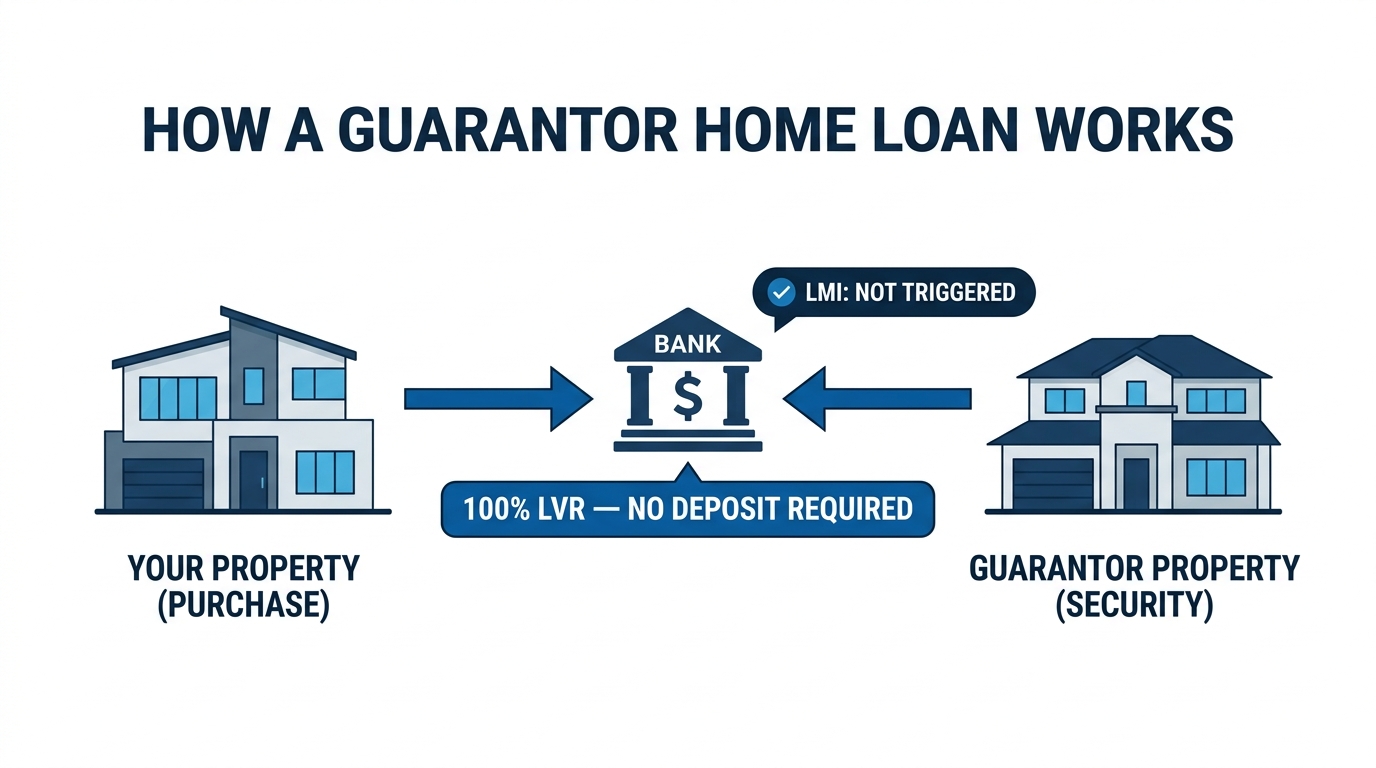
The Loan-to-Value Ratio (LVR) is the amount you borrow divided by the property’s purchase price. Standard home loans typically cap out at 80–95% LVR. Borrow above 80% LVR without a guarantor, and Lenders Mortgage Insurance (LMI) applies, an insurance premium that protects the lender if you default. LMI adds thousands of dollars to the cost of buying, sometimes tens of thousands on larger loans.
With a guarantor, the picture changes. The guarantor’s property provides security for the portion of the loan that would otherwise require a deposit. The lender’s effective risk is reduced to 80% LVR or below, which means LMI isn’t triggered, even if you’re borrowing the full purchase price.
This isn’t technically a “waiver” of LMI. LMI simply doesn’t apply because the guarantor removes the high-LVR risk that would normally activate it. The distinction matters for how borrowers should understand and explain the arrangement.
Can you borrow 100% with a guarantor?
Yes. With an eligible guarantor, most major Australian lenders will approve a loan for 100% of the property’s purchase price, and in some cases up to 105% to cover costs like stamp duty and legal fees. The guarantor’s property covers the security gap, removing the need for a cash deposit from the borrower.
A guarantor does not reduce your repayments. Repayments are set by the loan amount and the interest rate. A guarantor changes neither. What changes is your ability to buy now, rather than saving for years.
Interest rate advantage
This is an underappreciated benefit. Lenders typically price loans above 80% LVR at higher interest rates than loans at or below 80% LVR. A borrower taking a 90% or 95% LVR loan pays both LMI and a higher rate. A guarantor loan, by reducing the lender’s effective risk to 80% LVR, qualifies the borrower for the lower rate tier, the same rates available to someone who saved a full 20% deposit. Over the life of a $680,000 loan, the difference in rate alone can be material.
For a full breakdown of LMI costs and how the 80% LVR threshold works: what is LMI and when is it required
Wondering whether 100% borrowing is right for your situation? Read: can I borrow 100% of the property price
Guarantor Home Loans in Australia: Do Banks Accept Them?
Three of the four major banks accept family guarantee home loans through the broker channel. NAB effectively exited family guarantee lending through brokers on 25 May 2020. Their own guidance directs clients to alternative lenders for these scenarios. ANZ, Westpac, and CBA all have active products.
| Lender | Product name | Accepts grandparents? | Key notes |
|---|---|---|---|
| ANZ | Family Guarantee | Yes | Guarantee capped at 50% of guarantor property value; total lending capped at 70% LVR on guarantor’s property; no IO on guaranteed loan |
| Westpac | Family Security Guarantee | No | Grandparents explicitly excluded; eligible guarantors are parents, children, siblings; guarantee capped at 50% of guarantor property value |
| CBA | Family Security Support | Yes | Split loan structure (80/20); total lending on guarantor property capped at 70% LVR; broader eligible guarantor list including other family members subject to credit approval |
| NAB | N/A | N/A | Not available through broker channel for standard family guarantee scenarios since May 2020 |
Grandparent eligibility matters. If the guarantor is a grandparent, ANZ and CBA are the options. Westpac will not accept the application. CBA’s split loan structure (two separate loan applications rather than one loan with a guarantee attached) also has implications for refinancing and future loan management, which your broker can walk through.
Beyond the big four, many other lenders in our panel of 52+ also offer guarantor home loans. Eligibility criteria, guarantee structures, and release conditions vary considerably between lenders. Comparing across lenders rather than going directly to one bank is where a broker adds genuine value.
The 5% Deposit Scheme: a separate option
The Australian Government 5% Deposit Scheme (expanded 1 October 2025, no income caps, uncapped places) allows eligible first home buyers to purchase with a 5% deposit without paying LMI. This is a government guarantee rather than a family guarantee, and the two are distinct options. A guarantor loan and the 5% Deposit Scheme are different tools that suit different circumstances. For some borrowers, a family guarantor is the better fit; for others, the government scheme is simpler. A mortgage broker can help compare both.
5% Deposit Scheme explained | first home buyer loan options
The Risks of Being a Guarantor
Going guarantor on someone else’s home loan is a serious legal and financial commitment, not a formality. Before agreeing, any prospective guarantor needs to understand what they’re actually signing.
Liability if the borrower defaults
Family guarantees in Australia are typically limited guarantees. The guarantee covers a specific portion of the loan, generally around 20% of the property purchase price, which is the amount needed to reduce the effective LVR to 80%. If the borrower defaults, the lender’s recovery from the guarantor is capped at this limited amount. The lender cannot pursue the guarantor for the full outstanding loan balance.
In practice, this means the guarantor’s exposure is real but bounded. On a $680,000 purchase with a 100% loan, the guarantee amount is roughly $136,000, covering the portion that takes the loan from 80% to 100% LVR. If the borrower defaults and the property is sold, the lender recovers what it can from the property sale. Any shortfall within the guarantee amount can be sought from the guarantor. The guarantor is not responsible for the remaining loan balance beyond that.
This is still a real financial risk. Before agreeing, the guarantor should be clear on exactly how much they’re guaranteeing and under what circumstances that amount could be called.
Impact on the guarantor’s future borrowing
When the guarantor applies for credit in the future, they may be required to disclose any loans they’re guaranteeing. Some lenders will treat the guarantee as a contingent liability when assessing the guarantor’s borrowing capacity. This varies by lender. The guarantor should check with their own bank before entering the arrangement if they have near-term borrowing plans.
Credit record
Under Australia’s Comprehensive Credit Reporting (CCR) system, the guaranteed loan does not appear on the guarantor’s credit file. The borrower’s repayment history is reported against the borrower’s record, not the guarantor’s. A borrower missing payments will not directly appear on the guarantor’s credit report.
Relationship risk
Shared financial obligations can create real tension, particularly when the borrower’s circumstances change: job loss, relationship breakdown, health issues. The people who end up in the most difficult positions aren’t always those who default. They’re the ones who didn’t discuss the release plan upfront, or assumed the guarantee would quietly disappear without ever actively managing it.
Most lenders recommend that guarantors obtain independent legal and financial advice before signing. Some require it. A solicitor will walk through what the guarantor is agreeing to, confirm they understand the liability, and give both parties the chance to raise concerns before any documents are signed.
Guarantor Home Loans: Examples & Scenarios
Example 1: First home buyer with a parent guarantor
Sarah, 29, earns $90,000 a year and wants to buy a $680,000 apartment in Western Sydney. She has $25,000 in savings, not enough for a 20% deposit ($136,000) and not sufficient for most standalone low-deposit products.
Her parents own their home, valued at $950,000, with $320,000 remaining on their mortgage. Their equity is $630,000. The lender uses $136,000 of that equity as additional security for Sarah’s loan.
Sarah borrows the full $680,000. No LMI applies because the guarantor’s equity reduces the lender’s effective risk to below 80% LVR. Her parents make no payments. They’re called on only if Sarah defaults, which doesn’t happen.
Once Sarah’s loan balance is no more than 80% of the property’s current value, whether through repayments, property price growth, or both, she can apply to have the guarantee released without LMI. If the apartment appreciates to $750,000 while her balance is still $580,000, her LVR is already at 77.3% and the guarantee can be released. She doesn’t need to wait until her balance drops to 80% of the original purchase price.
Example 2: A limited guarantee between siblings
Michael and Kate are siblings. Michael bought a home three years ago. It’s now valued at $820,000 with $330,000 remaining. His equity is $490,000. Kate is a first home buyer with stable income but minimal savings.
Kate wants to buy a $560,000 property. The lender uses $112,000 of Michael’s equity (covering the deposit gap to reach 80% LVR on Kate’s loan) as a limited guarantee. Kate borrows the full $560,000. Michael’s total property and loan position aren’t affected day-to-day. Once Kate’s LVR reaches 80%, Michael is released.
Model your own scenario
The numbers vary depending on the lender, the property value, and your guarantor’s equity position. Use our guarantor home loan calculator to estimate borrowing capacity, the equity your guarantor needs to provide, and the timeframe to release.
Comparing a guarantor loan against other deposit options? Read: gift vs guarantor for home loan deposit
Key Questions About Guarantor Home Loans
Does a guarantor reduce my loan repayments?
No. A guarantor does not reduce repayments. Repayments are calculated from the loan amount and interest rate. A guarantor affects neither. A $680,000 loan at 6.2% per annum carries the same monthly repayment whether you have a guarantor or not. The guarantor’s role is to enable the loan in the first place, not to reduce what you pay.
When can a guarantor be released?
The guarantee can be released once your loan balance is at or below 80% of the property’s current value, without requiring LMI. This is confirmed through a current property valuation. If the property has increased in value since purchase, your LVR may already be below 80% even if your loan balance hasn’t dropped significantly.
The guarantee doesn’t end automatically. You need to formally apply through your lender or mortgage broker, who will request a valuation and confirm the LVR. Making additional repayments accelerates the process, but property growth can do a lot of the work too.
Can I use a guarantor as a first home buyer?
Yes. First home buyers are the most common users of guarantor loans, because the obstacle is usually the deposit rather than the ability to meet repayments. Before committing to a guarantor arrangement it is worth comparing it against the low-deposit options available to first home buyers, including the 5% Deposit Scheme covered above, since the right choice depends on your savings, your borrowing capacity and whether a suitable guarantor is available.