

NSW Land Tax 2026: Threshold, Rates & What You’ll Pay
NSW land tax 2026: thresholds, rates and what you will pay
On this page ▾
- NSW land tax thresholds and rates for 2026
- How much land tax will I pay? Worked examples
- How land tax is calculated in NSW
- Who pays land tax in NSW, and who does not
- Land tax exemptions: your home, the six-year rule and more
- When land tax is due and how to pay
- Land tax and your investment loan
- Frequently asked questions
NSW land tax is an annual state tax on the unimproved value of the land you own at midnight on 31 December, charged by Revenue NSW under the Land Tax Management Act 1956.
For the 2026 land tax year, NSW land tax is nil on combined taxable land value up to $1,075,000, then $100 plus 1.6% of the land value above $1,075,000. Above the premium threshold of $6,571,000 the rate becomes $88,036 plus 2% of the value over $6,571,000.
Your home is usually exempt, so in practice land tax is a cost of holding investment property. A combined investment land value of $1.2 million costs $2,100 a year, $2 million costs $14,900, and $6 million costs $78,900. Between the two thresholds, each extra $100,000 of land value adds $1,600 a year. The value used is the average of your last three Valuer General land values, not the price you paid.
Thresholds and rates in this article are Revenue NSW’s figures for the 2026 land tax year (taxing date midnight 31 December 2025), which have applied unchanged since the 2024 land tax year. They come from Revenue NSW’s thresholds and rates page, checked 26 September 2026.
We have financed property investors in Sydney since 2001, and land tax is the holding cost that most often surprises them on their second property. This guide sets out the numbers first, then the exemptions, then what land tax does to your loan.
NSW land tax thresholds and rates for 2026
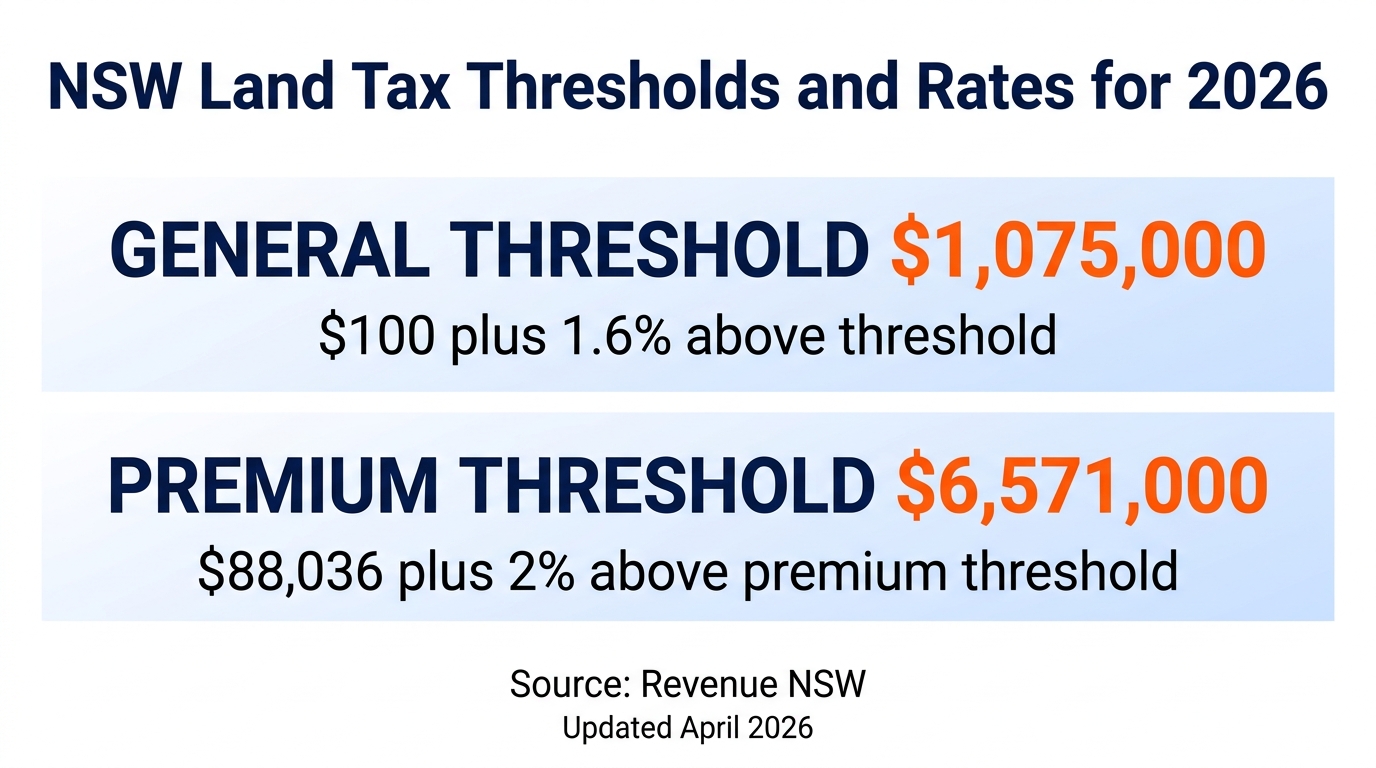
| Combined taxable land value | Land tax payable (individuals and companies) |
|---|---|
| Up to $1,075,000 | Nil |
| $1,075,001 to $6,571,000 | $100 + 1.6% of the value above $1,075,000 |
| Above $6,571,000 | $88,036 + 2% of the value above $6,571,000 |
The $88,036 is the tax payable at exactly $6,571,000, so there is no jump at the premium threshold. What changes is the rate on each extra dollar, from 1.6% to 2%.
The threshold freeze, and what it means for 2027
The 2024-25 State Budget froze both thresholds at their 2024 levels for later land tax years, and Revenue NSW confirmed $1,075,000 and $6,571,000 for 2026 in its 2026 land tax year notice. Revenue NSW’s 2025 notice says the thresholds will stay unchanged for future land tax years, and that the Treasurer will assess them by 1 June 2027.
The next taxing date is midnight 31 December 2026, which sets your 2027 land tax. The 2026-27 NSW Budget, delivered on 23 June 2026, made no change to land tax thresholds or rates. Unless the law changes before then, expect the 2027 figures to be the same as 2026.
A frozen threshold matters more than it sounds. Land values keep moving while the threshold does not, so owners drift into the tax, or further into it, without buying anything.
NSW land tax threshold history
| Land tax year | General threshold | Premium threshold |
|---|---|---|
| 2024 onwards (including 2026) | $1,075,000 | $6,571,000 |
| 2023 | $969,000 | $5,925,000 |
| 2022 | $822,000 | $5,026,000 |
| 2021 | $755,000 | $4,616,000 |
| 2020 | $734,000 | $4,488,000 |
| 2019 | $692,000 | $4,231,000 |
Source: Revenue NSW, land tax thresholds and rates.
How much land tax will I pay? Worked examples
The table below applies the 2026 rates to a range of combined land values. The right-hand column shows what a special trust (most family and discretionary trusts) pays on the same land, because it gets no threshold.
| Combined taxable land value | Individual or company, per year | Per week | Special trust, per year |
|---|---|---|---|
| $1,075,000 | Nil | Nil | $17,200 |
| $1,200,000 | $2,100 | $40 | $19,200 |
| $1,500,000 | $6,900 | $133 | $24,000 |
| $2,000,000 | $14,900 | $287 | $32,000 |
| $3,000,000 | $30,900 | $594 | $48,000 |
| $6,000,000 | $78,900 | $1,517 | $96,000 |
| $7,000,000 | $96,616 | $1,858 | $113,716 |
These are estimates using the published rates. For your own figure, the Revenue NSW land tax calculator uses the same formula for individuals and most companies (it does not handle special or discretionary trusts, or related companies), and your assessment notice is the final word.
Example 1: $1.2 million of land (one or two investment properties)
- Excess over the threshold: $1,200,000 – $1,075,000 = $125,000
- Tax on the excess: $125,000 x 1.6% = $2,000
- Add the $100 base: $2,100 a year, about $40 a week
This is the figure Revenue NSW itself uses in its surcharge land tax example.
Example 2: $2 million of land
- Excess: $2,000,000 – $1,075,000 = $925,000
- Tax on the excess: $925,000 x 1.6% = $14,800
- Add $100: $14,900 a year, about $287 a week
That is real money against the rent. Run it through your rental figures before you buy, not after the first notice arrives.
Example 3: $6 million of land
- Excess: $6,000,000 – $1,075,000 = $4,925,000
- Tax on the excess: $4,925,000 x 1.6% = $78,800
- Add $100: $78,900 a year, about $1,517 a week
This portfolio sits $571,000 under the premium threshold. The next purchase that pushes it past $6,571,000 is taxed at 2% on every dollar above that line.
How land tax is calculated in NSW
Revenue NSW adds up the land value of all the non-exempt land you own in NSW at midnight on 31 December, applies the threshold and rates, and issues an assessment for the following calendar year. Land tax is not pro-rated: own taxable land at that moment and you pay the full year, even if you sell in February.
Land value is a three-year average, not the price you paid
Land tax uses the unimproved value of the land only, set by the NSW Valuer General as at 1 July each year. Revenue NSW averages the three most recent values. Its own example: values of $1,050,000, $1,100,000 and $1,150,000 average $1,100,000, which produces $500 of land tax.
The averaging smooths out a single big jump. It also means a bill can keep rising for two years after land values flatten. If a value looks wrong, you have 60 days from your notice of valuation or land tax assessment to lodge an objection with the Valuer General.
Who pays land tax in NSW, and who does not
Most owner-occupiers pay nothing, because their home is exempt and they own no other taxable land. Land tax mainly applies to:
- investors whose combined NSW investment land value is above $1,075,000
- owners of holiday homes, vacant land or commercial property
- special trusts, which pay from the first dollar
- foreign persons owning residential land, who also pay surcharge land tax
The second-property trap
Each property can sit under the threshold on its own and still be taxed, because Revenue NSW adds them together. Take two investment properties with land values of $700,000 and $600,000. Alone, neither attracts tax. Together they total $1,300,000, which costs $3,700 a year: ($1,300,000 – $1,075,000) x 1.6% + $100.
This is the conversation we have most often with second-property buyers. The first investment never produced a land tax bill, so the second one gets budgeted without it.
Joint owners get one threshold, not two
Joint owners are assessed together as a single “primary taxpayer” with one threshold for the land they share. Each owner is then assessed separately on their share plus any land they own alone, with a secondary deduction so the same land is not taxed twice. Buying jointly does not double the threshold.
Trusts and companies
- Special trusts (family and discretionary trusts, and unit trusts that do not meet the fixed trust definition) get no threshold. They pay 1.6% up to the premium threshold, then 2%. A $600,000 property in a family trust costs $9,600 a year, where an individual would pay nothing. A discretionary trust whose deed does not exclude foreign beneficiaries can also be charged surcharge land tax.
- Fixed trusts whose deed meets Revenue NSW’s definition do receive the threshold.
- Companies receive the threshold, but in a group of related companies only one (the concessional company) gets it. The others pay without a threshold.
Structure is decided at purchase and is expensive to unwind, so get accounting and legal advice first. Our guide to structuring investment property ownership covers the lending side.
Foreign owners: surcharge land tax
Foreign persons who own residential land in NSW pay surcharge land tax at 5% of the land value from the 2025 land tax year (4% in 2023 and 2024). There is no threshold. On $2,000,000 of residential land, a foreign owner pays $14,900 of ordinary land tax plus $100,000 of surcharge, $114,900 in total.
Land tax exemptions: your home, the six-year rule and more
Principal place of residence
Your home is exempt if you meet the principal place of residence rules. The main ones:
- You have continuously lived in it, solely for residential use, since 1 July before the 31 December taxing date. If you moved in later, the exemption can still apply if it is your home on the taxing date.
- From the 2026 land tax year, the people living in the property must together own at least 25% of it. A resident owning 10% on their own no longer qualifies.
- A home you are building or renovating can be exempt for up to 4 years. If you buy a new home before selling the old one, both can be exempt for one year when the conditions are met.
An investment property counts toward your land tax from the first 31 December you own it, even if you are renting elsewhere. That catches out rentvestors who assume their one property is covered.
What is the six-year rule for land tax in NSW?
You can move out of your home and keep the exemption for up to six years. You must have lived in it continuously for at least six months first, and you cannot own and live in another home in the meantime. The catch is the letting limit. Under Revenue NSW ruling LT 082, you can rent it out for no more than a continuous six months, or a total of 182 days in the calendar year before each taxing date. Rent it out for longer and land tax generally applies the following year, unless you move back in before 31 December.
This is not the capital gains tax six-year rule, which lets you rent out a former home for up to six years and still treat it as your main residence for CGT. Mixing the two up is an expensive mistake, because the land tax version allows only about six months of letting a year.
Other exemptions and concessions
- Primary production land, where the dominant use is primary production (such as farming) carried on for profit.
- Build-to-rent, where eligible projects of at least 50 dwellings get a 50% reduction in land value for land tax purposes.
- Land used for boarding houses, aged care, childcare, caravan parks and non-profit organisations. The full list is on Revenue NSW’s exemptions and concessions page.
When land tax is due and how to pay
Revenue NSW sends annual assessment notices from January (for 2026, from Monday 19 January). The due date is 60 days after the notice is issued. Your payment options are:
- Pay in full before the due date and receive a 0.5% discount.
- Pay by instalments over 3, 6 or 9 months, fortnightly or monthly. The payment plan carries no interest if you set it up before the due date. Miss an instalment and Revenue NSW cancels the plan and charges interest back to the original due date.
If you think you owe land tax and no notice has arrived, request a Land Tax Online login so Revenue NSW can assess you, rather than wait. The tax is owed whether or not a notice arrives.
Land tax and your investment loan
Land tax is a state tax, but it shows up in three places on the finance side.

Serviceability. Lenders do not treat land tax as a separate commitment when you apply for the next loan. It is expected to sit inside the investment property expenses you declare. Almost every lender also shades the rent it counts, commonly to 80%, and some rely on that shading alone rather than assessing your declared expenses property by property. Where your declared expenses are higher than the shading allows for, some lenders count an even lower share of the rent. Since the 2026 negative gearing changes reduced investors’ borrowing capacity, some lenders have eased their shading, and a few now count up to 95% of the rent.
Tax returns are where land tax gets tested. If you are self-employed and your tax returns go in with the application, lenders expect the expenses you declare for each property to match the return: the year’s total expenses for that property, less interest and depreciation, divided by 12. Land tax is on that return, so it counts, although a genuine one-off cost can sometimes be excluded. A managing agent’s statement showing a month of high expenses that do not line up with what you declared can also draw questions. Either way, a property that pushes your combined land value over the threshold adds an annual cost, and that can reduce what you can borrow for the purchase after it. We model the next two purchases together for that reason. Our guide to how banks assess borrowing capacity explains the rest of the calculation, and our borrowing power calculator gives a first estimate.
Cash-flow timing. Land tax arrives as one bill early in the year, not monthly like your repayments. Set the money aside through the year, for example in an offset account (usually against your home loan first, because that interest is not tax deductible), or use the instalment plan. Timing a settlement matters too, because ownership is tested at midnight on 31 December. A purchase that settles on 2 January is not counted until the following taxing date. One that settles on 30 December is counted for the whole of the next year. Ask your conveyancer whether the contract adjusts land tax at settlement.
Rental yield and tax. Put land tax into your rental yield calculation alongside council rates and management fees. Two properties earning $30,000 a year in combined net rent before land tax earn $26,300 after the $3,700 bill from the example above. Land tax on a rental property is deductible, and the ATO says to claim it in the income year the liability relates to, not the year you pay it. From 1 July 2027, whether a resulting loss can reduce tax on your salary depends on when you bought and what you bought, under the 2026 negative gearing changes. Confirm your position with your accountant.
If you are weighing another purchase or using equity to buy an investment property, speak to us about residential investment loans. We compare 52+ lenders and will put the land tax figure into the numbers before you commit, so the first assessment notice is not the first time you see it.
Frequently asked questions
How much is land tax in NSW?
For the 2026 land tax year, NSW land tax is nil on combined taxable land value up to $1,075,000, then $100 plus 1.6% of the value above $1,075,000, up to $6,571,000. Above $6,571,000 it is $88,036 plus 2% of the excess. A combined land value of $1.2 million costs $2,100 a year, $2 million costs $14,900 and $6 million costs $78,900.
What is the NSW land tax threshold for 2026?
The general threshold is $1,075,000 and the premium threshold is $6,571,000. Both have been frozen since the 2024 land tax year. The 2026-27 NSW Budget made no change, so the same figures are expected for the 2027 land tax year (taxing date 31 December 2026). The Treasurer is due to assess the thresholds by 1 June 2027.
Do I have to pay land tax on an investment property in NSW?
Only if the combined land value of all your taxable NSW land is above $1,075,000. One investment property with a land value under the threshold usually attracts no land tax, but a second property is added to the first. An apartment is taxed on its share of the strata scheme’s land value, not the building. Special trusts pay from the first dollar.
Do you pay land tax on your own home in NSW?
Generally no. Your principal place of residence is exempt if you have lived in it continuously since 1 July before the 31 December taxing date, or it is your home on that date. From the 2026 land tax year, the people living there must together own at least 25% of the property.
What is the six-year rule for land tax in NSW?
You can move out of your home and keep the land tax exemption for up to six years. You must have lived there for at least six months first and cannot own and live in another home in the meantime. You can only rent it out for up to six months continuously, or 182 days in total, in the calendar year before each taxing date. Rent it for longer and land tax generally applies the following year, unless you move back in before 31 December.
How can I reduce land tax in NSW?
Lawful options include claiming every exemption you qualify for and objecting within 60 days if the Valuer General’s land value looks wrong. Choose an ownership structure carefully before you buy, because special trusts get no threshold. Settlement timing around 31 December can also change which year a property is first counted. Get tax and legal advice for your situation.
Is land tax the same as council rates?
No. Council rates are charged by your local council on every property you own, including your home. Land tax is charged by Revenue NSW, usually only on combined taxable land above the threshold (special trusts and foreign owners’ surcharge land tax get no threshold). Stamp duty is different again: a one-off duty paid when you buy.
Can I claim land tax as a tax deduction?
Yes, if the property earns rental income. The ATO says to claim it in the income year the liability relates to, not the year you pay it. Land tax on your own home is not deductible. This is general information only; speak to your accountant about your situation.
Patrick O’Brien, Director and Home Loan Specialist since 2001
This article contains general information only and does not constitute financial advice. Your personal financial situation, objectives and needs have not been considered. Before acting on any information, you should consider its appropriateness to your circumstances. Speak to a qualified mortgage broker for advice tailored to your situation. Mortgage World Australia Pty Ltd is a credit representative (CR No. 396946) of Mortgage Specialists Pty Ltd (Australian Credit Licence No. 387025).

Patrick is a Director and a Home Loan Specialist. He has been helping Australians with home loans since 2001. Prior to working as a mortgage broker Patrick was employed by Macquarie Bank for 3 years and also worked as an accountant for a publicly listed company. Patrick’s qualifications include:
Bachelor of Business, UTS Sydney. Majored in accounting and sub-majored in Finance and Marketing.
Diploma of Finance and Mortgage Broking Management FNS50310
Certificate IV in Financial Services (Finance/Mortgage Broking) FNS40804
Ready to Take the Next Step?
Whether you’re looking to buy your first home, refinance, or explore investment opportunities, Mortgage World Australia is here to help.
Fill out the contact form below, and one of our expert mortgage brokers will be in touch shortly to discuss your needs and guide you through your options.
Get Started Today!