

Investment Property Capital Gains Tax: 2026 Guide
Investment Property Capital Gains Tax: The Complete Guide
Capital gains tax is one of those topics most investors understand in principle but get wrong in practice. They know a tax bill is coming when they sell. What catches them off guard is the size of it, what they can actually do about it, and — this is the critical part — that the decisions made at purchase often determine the outcome years later.We’ve worked with investors who sold at month 11 of ownership to free up cash — and lost the 50% CGT discount on a $200,000 gain. Others chose the wrong ownership structure before purchase and faced a tax bill that would have been a third lower in a different entity. Both were avoidable. This guide walks you through the calculation, the main exemptions you can actually use, and how CGT shapes your financing decisions from day one.What Is Capital Gains Tax on an Investment Property?
On this page ▾
Which properties attract CGT?
CGT applies to investment properties — any property that is not your main residence. This includes residential rental properties, commercial properties, holiday homes you rent out, and vacant land purchased for investment.Your principal place of residence is generally exempt. But the line blurs when a property has served both purposes: as your home at one point and as a rental at another. In those cases, the ATO applies a proportional calculation.What triggers a CGT event?
The most common CGT event (CGT Event A1) is a sale. But CGT can also be triggered by transferring ownership to another person (including a spouse), gifting a property, granting a long-term lease, or receiving an insurance payout after the property is destroyed.The CGT clock starts at settlement date — the date legal ownership transfers — not when you sign the contract.How to Calculate Capital Gains Tax on an Investment Property
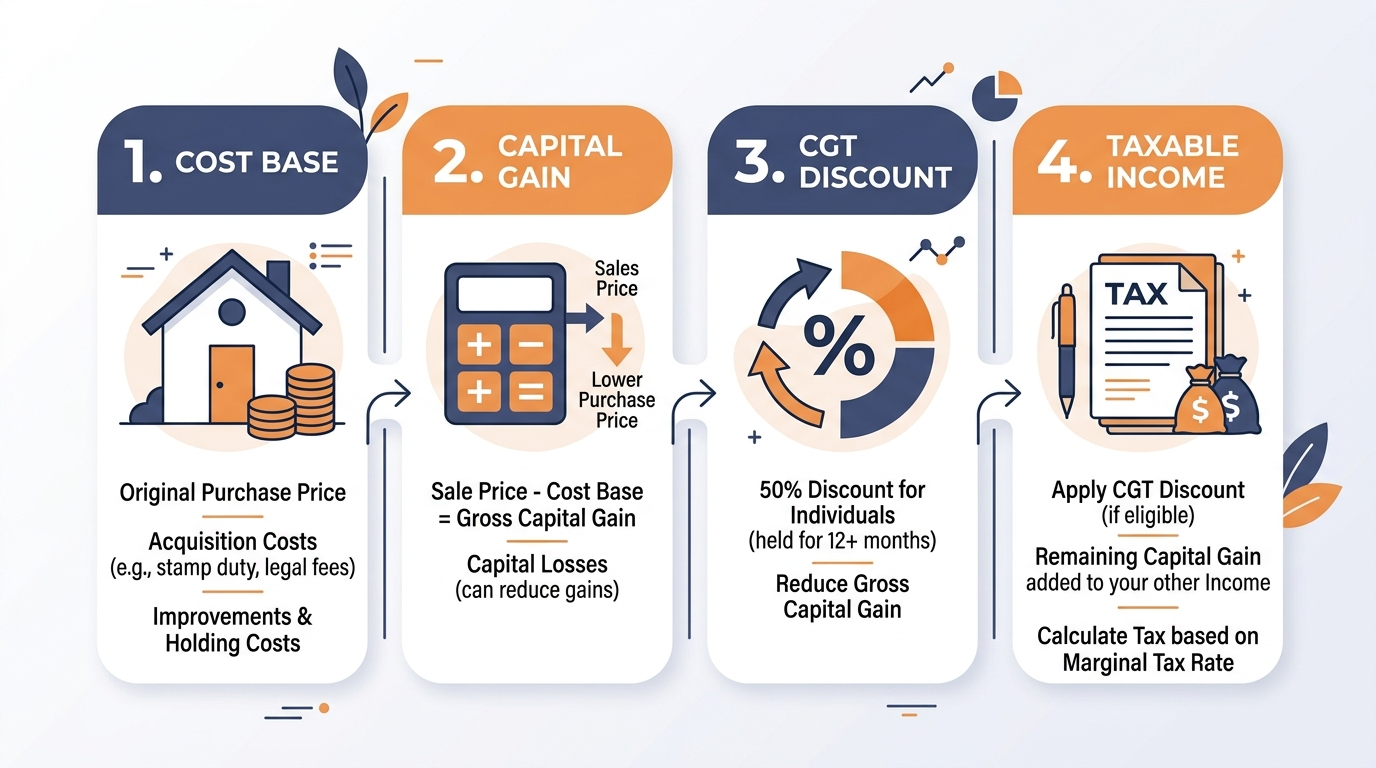 The calculation runs in four steps. This is where investors most commonly make mistakes — usually by underestimating their cost base or forgetting about depreciation recapture.
Step 1 — Work out your cost base
Your cost base is not just the purchase price.It includes every allowable cost associated with acquiring, owning (for capital improvements), and selling the property:- Purchase price
- Stamp duty and conveyancing fees on purchase
- Building inspection and pest inspection costs
- Capital improvements (additions, renovations — not repairs or maintenance)
- Real estate agent commission on sale
- Legal fees on sale
- Title search and transfer costs
Step 2 — Calculate your capital gain
Capital gain = Sale price − Cost baseIf your cost base exceeds the sale price, you have a capital loss. Capital losses cannot be offset against ordinary income — they can only be carried forward to offset future capital gains.Step 3 — Apply the 50% CGT discount (if eligible)
Own the property for more than 12 months as an individual taxpayer, and you qualify for the 50% CGT discount. Half the gain is added to your taxable income. Half.That discount is the biggest tax break available to Australian property investors. And it’s the reason selling at month 11 to dodge some other financial issue is one of the costliest timing mistakes we see.SMSFs in accumulation phase receive a one-third (33.3%) discount instead of 50%. SMSFs in pension phase pay no CGT at all. Companies receive no discount.Step 4 — Add the gain to your taxable income
After applying the discount, the remaining gain is added to your taxable income for the year. There’s no separate CGT rate — you pay whatever marginal rate applies to the combined income.This is why the timing of a sale matters. Sell in a year when your income is high — a bonus year, a year with other investment sales — and you’ll pay a higher rate on the same gain than if you sold in a lower-income year.How Much Capital Gains Tax Will You Pay?
CGT by ownership structure: individual, SMSF, company
The structure you hold the property in determines the applicable CGT treatment. This is a decision that needs to be made before purchase — not after.| Ownership structure | CGT discount | Effective rate on gain |
|---|---|---|
| Individual (held 12+ months) | 50% | Marginal rate applied to 50% of gain |
| SMSF — accumulation phase (held 12+ months) | 33.3% | ~10% effective |
| SMSF — pension phase | Nil tax on fund earnings | 0% |
| Company | No discount | 30% flat (or 25% base rate entity) |
| Discretionary trust (distributed to individuals) | 50% (if held 12+ months) | Beneficiary’s marginal rate on 50% |
Worked example: $800,000 sale price
Say you bought a property in 2015 for $450,000. You paid $18,500 in stamp duty and $2,000 in legal fees. In 2019 you did a $30,000 kitchen and bathroom renovation — capital work, not maintenance. Total cost base: $500,500.Fast forward to 2026. You sell for $800,000.Your capital gain: $299,500With the 50% discount (held 11 years): $149,750 gets added to your taxable income.If you earned $100,000 from other sources that year, your total taxable income is now $249,750. The actual CGT bill comes from applying marginal rates to that $149,750 gain portion.For a sense of scale: a $300,000 gain after the 50% discount adds $150,000 to your taxable income. The approximate additional tax at three different starting income levels (2025–26 rates, including Medicare levy — verify current rates at ato.gov.au):| Base income before sale | Discounted gain added | Approx. CGT payable |
|---|---|---|
| $60,000 | $150,000 | ~$55,000 |
| $100,000 | $150,000 | ~$61,000 |
| $150,000 | $150,000 | ~$67,000 |
CGT Exemptions and Concessions
The main residence exemption
Your primary place of residence is fully exempt from CGT. But the exemption becomes partial when a property has served dual purposes.The ATO calculates a proportional exemption based on the time the property was your main residence versus the time it was an investment. If you owned a property for 20 years, lived in it for 5 years, and rented it out for 15 years, only 25% of the gain is exempt — the remaining 75% is assessable.The CGT 6-year absence rule
This rule catches a lot of investors off guard — in a good way.If you move out and rent the place, you can treat it as your main residence for CGT purposes for up to 6 years, even though you’re no longer living there. Sell within those 6 years and haven’t declared another property as your main residence, and you pay no CGT on the sale.Two conditions apply: the property was your main residence when you moved out, and you haven’t nominated another property as your main residence during the claim period.The 6-year clock resets each time you move back in — which makes it particularly useful for people who move interstate for work and keep their original home as a rental.The 6-month overlap rule
If you purchase a new home before selling your existing one, you can treat both properties as your main residence for up to 6 months simultaneously. This gives you a buffer to sell without triggering CGT on the first property — provided that property was your main residence for at least 3 months in the 12 months prior.Pre-CGT properties (acquired before 20 September 1985)
Properties acquired before 20 September 1985 are fully exempt from CGT. The original acquisition is exempt; however, substantial improvements or reconstructions undertaken post-CGT introduction may create a separate CGT liability on those improvements.How to Minimise CGT on Your Investment Property
Hold the property for at least 12 months
This is the most straightforward CGT reduction available. A 50% discount for a 12-month hold is a significant concession. Selling at month 11 foregoes that discount entirely — a costly mistake on a property with a large gain.Offset capital losses
Capital losses from other investments — shares, another property, other assets — can offset your capital gain in the year of sale. Genuine losses from other investments can legitimately reduce the assessable gain. Losses cannot be manufactured purely to reduce CGT, but real portfolio losses do count.Time the sale in a lower-income year
CGT is income. Selling in a year when your other income is lower — after retiring, during parental leave, in a business downturn year, or after reducing hours — can mean the gain is taxed at 30% instead of 47%. On a $150,000 discounted gain, that difference is around $25,500. It’s worth planning the timing with your accountant. We’ve seen investors leave that on the table simply by not thinking about it 12 months in advance.Review your ownership structure before buying
The ownership structure you choose at purchase determines your CGT outcome at sale. Individuals get the 50% discount. SMSFs in pension phase pay zero. Companies pay 30% flat with no discount.Changing the structure after purchase is difficult, expensive, and often triggers its own CGT event. We help investors think through the ownership decision before they sign a contract — including how the chosen structure affects lending options, borrowing capacity, and lender access. More on this in our guide to investment property ownership structure.How CGT Affects Your Investment Property Financing Decisions
 This is where a mortgage broker adds value that most CGT articles don’t cover.CGT is a tax event at sale. But it’s shaped entirely by the decisions made at purchase. That’s the lens we bring to investment property clients at Mortgage World Australia.Hold versus refinance. Many investors assume selling is the only way to access built-up equity.Here’s the thing: refinancing to release equity is often the better move. You keep the asset, defer the CGT event indefinitely, and still redeploy the capital. On a $600,000 gain, the CGT bill at the top marginal rate is around $141,000. You can potentially avoid this if you refinance instead of selling. Most lenders will allow refinancing up to 80% LVR, so the equity you can access depends on the property’s current value and your remaining debt. But for many investors, that’s still substantial capital, and it costs nothing in CGT. That comparison is worth running before you decide to sell.Ownership structure and borrowing. Buying an investment property in a trust or SMSF can deliver CGT advantages, but these structures materially affect your lending options. Not all lenders offer SMSF loans, and those that do typically require higher deposits and charge higher rates. Trust borrowing has a different serviceability treatment. The CGT benefit needs to be weighed against the lending constraints — ideally before you buy, with input from both an accountant and a mortgage broker. Our guide to investing in property through an SMSF covers this in detail.Net proceeds planning. If you’re selling one investment property to fund the purchase of another, the CGT liability reduces the capital available for the next purchase. Modelling the net proceeds — after CGT, agent fees, and legal costs — is essential when assessing whether the upgrade stacks up financially. We work through this with investors as part of the borrowing capacity assessment.Negative gearing and CGT together. Negative gearing reduces your holding costs. CGT applies when you sell. They’re two parts of the same investment equation. Most investors think about them separately — we connect them. Our negative gearing guide covers how the two interact.Speak to a mortgage broker at Mortgage World Australia — we can help you structure your investment property purchase to minimise long-term CGT exposure while ensuring the structure works for your lending needs.
Frequently Asked Questions
What is the 6 year rule for capital gains tax on investment property?
The 6-year absence rule allows you to treat a former main residence as your principal place of residence for CGT purposes for up to 6 years after you move out and begin renting it out. If you sell within that 6-year window and no other property was your main residence during that time, the sale is fully CGT-exempt. The 6-year period resets each time you move back in, making it useful for investors who move temporarily for work.Do retirees pay capital gains tax in Australia?
This one surprises people. Yes — retirees pay CGT at their marginal income tax rate, the same as anyone else. The practical benefit is that most retired individuals have lower taxable income, which means the same gain is taxed at a lower rate than it would have been during peak earning years. The significant exception is assets held through an SMSF in pension phase: earnings in that phase are tax-free, so a property sold from an SMSF in full pension mode incurs zero CGT.How much CGT will I pay on a $300,000 gain?
With the 50% CGT discount applied (assuming you’ve held for 12+ months as an individual), $150,000 is added to your taxable income. The tax payable depends on your other income in the year of sale. At $60,000 base income, the CGT is approximately $55,000. At a $100,000 base income, approximately $61,000. At $150,000, approximately $67,000. These figures are indicative, based on 2025–26 individual marginal rates including Medicare levy — verify current rates at ato.gov.au and confirm your specific liability with your accountant.Can I avoid CGT by moving into my investment property?
Partially. Moving in makes the property your main residence from that point forward — so future gains are CGT-exempt. But the gain that accrued while the property was an investment is still assessable. The ATO calculates the assessable portion based on the proportion of your ownership period during which the property was an investment. Moving in doesn’t eliminate the historical gain; it stops new gain accruing.What happens to CGT if I hold my investment property in a company?
Companies pay CGT at the corporate tax rate — currently 30%, or 25% for base rate entities — with no 50% discount. This makes companies less tax-efficient than individual or SMSF structures for long-term property investments in most cases. Companies can offer other advantages, including asset protection and income distribution flexibility, but the absence of the CGT discount is a significant cost for buy-and-hold investors. This is a decision worth making with both a tax adviser and a mortgage broker before you purchase.This article provides general information about capital gains tax as it applies to investment property in Australia. It does not constitute financial or tax advice. CGT rules are complex and your individual circumstances will affect the outcome. We recommend speaking with a qualified accountant or registered tax agent for advice specific to your situation. Mortgage World Australia provides mortgage broking services only.Patrick O’Brien — Director and Home Loan Specialist since 2001. Mortgage World Australia has access to 52+ lenders.

Patrick is a Director and a Home Loan Specialist. He has been helping Australians with home loans since 2001. Prior to working as a mortgage broker Patrick was employed by Macquarie Bank for 3 years and also worked as an accountant for a publicly listed company. Patrick’s qualifications include:
Bachelor of Business, UTS Sydney. Majored in accounting and sub-majored in Finance and Marketing.
Diploma of Finance and Mortgage Broking Management FNS50310
Certificate IV in Financial Services (Finance/Mortgage Broking) FNS40804
Ready to Take the Next Step?
Whether you’re looking to buy your first home, refinance, or explore investment opportunities, Mortgage World Australia is here to help.
Fill out the contact form below, and one of our expert mortgage brokers will be in touch shortly to discuss your needs and guide you through your options.
Get Started Today!