Fixed vs variable home loan: complete guide 2026
Fixed vs variable home loan: which is right for you?
On this page ▾
- Understanding fixed rate home loans
- Understanding variable rate home loans
- Fixed vs variable: side-by-side comparison
- Is it better to get a fixed or variable loan?
- Which loan type suits your situation?
- Fixed vs variable in today’s interest rate environment
- Switching between fixed and variable
- Frequently asked questions
- About the author
Choosing between a fixed and variable home loan is one of the most important decisions you’ll make when borrowing. The type of loan you choose affects how much you pay each month, how much financial protection you have, and what happens when interest rates change. This guide breaks down both options, compares them side by side, and helps you find the right fit for your situation. For a more timely take focused on the post-May-2026-RBA-hike environment, read our May 2026 broker analysis on whether to fix your home loan.
Understanding fixed rate home loans
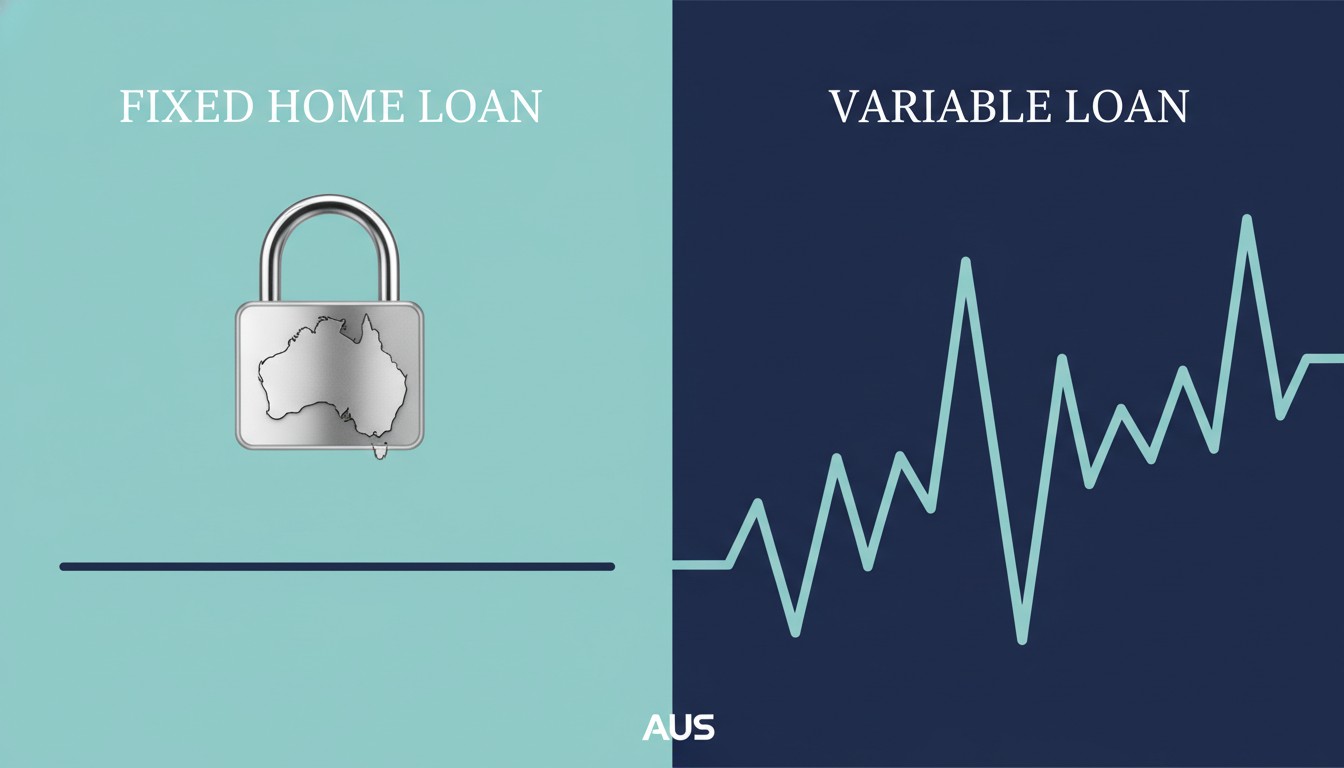
A fixed rate home loan locks your interest rate for a specific period. During that time, your rate and your monthly repayment amount don’t change, no matter what happens to market rates.
How fixed rates work
When you fix a rate, your lender sets your interest rate based on what they pay to borrow funds at a future date. That’s why fixed rates are typically priced off “forward swap rates” rather than the current RBA cash rate. Right now, in April 2026, with the RBA cash rate at 4.10%, fixed rates are generally 0.40–0.90 percentage points higher than variable rates, reflecting the lender’s cost to lock in long-term funding. There are some exceptions to this, with some lenders offering lower fixed rates, but at the time of writing, they are on the way up.
When your fixed term ends (usually 1–5 years), your loan automatically rolls to a variable rate, and you’ll pay whatever rate applies at that time.
Fixed rate advantages
Certainty: Your repayment amount is fixed for the entire term. If rates rise sharply, your monthly cost doesn’t change. This predictability makes budgeting easier, especially if you have tight cash flow.
Protection against rate rises: If the RBA raises rates significantly during your fixed term, you’re protected. Your neighbour with a variable loan might see their repayment jump; yours stays the same.
Simplified planning: You know exactly what you’ll pay each month. No surprises, no guessing how rate changes will affect your position.
Fixed rate disadvantages
Higher upfront cost: Fixed rates are currently more expensive than variable rates. You’re paying for certainty and protection, and that costs money upfront.
Limited flexibility: Most fixed rate loans restrict or ban extra repayments, redraws, and offset accounts. If you want to pay down your loan faster or access cash during tough times, you may face limitations or penalties.
Break costs: If you need to exit a fixed loan early (to refinance or switch lenders), you could face break costs. These are calculated based on the difference between your fixed rate and the current wholesale rate. If rates have fallen since you locked in, the cost can be substantial. This is one of the biggest gotchas with fixed loans.
Loss of rate drop benefit: If rates fall during your fixed term, you can’t benefit immediately. You’re locked in at the higher rate until your term ends.
Understanding variable rate home loans
A variable rate home loan means your interest rate moves with the market. When rates rise or fall, your loan rate adjusts, and your monthly repayment changes with it.
How variable rates work
Your variable rate has two components: the RBA cash rate and your lender’s margin (usually 2.5–3.0%, depending on the lender and your LVR). When the RBA moves, your rate moves. When your lender adjusts their margin (which happens occasionally), your rate adjusts too. Right now, big four banks are charging around 5.99% variable on home loans, while smaller lenders and non-banks sit lower at 5.78%+. This is why shopping around matters: there’s a 20+ basis point gap.
Variable rate advantages
Lower current rates: Variable rates are roughly 0.40–0.70 percentage points cheaper than fixed rates right now. If you can afford the uncertainty, you save money immediately.
Full flexibility: You can usually make unlimited extra repayments, use a redraw facility to access that money if needed, and enjoy an offset account (where you hold savings at your offset rate to reduce interest charged). This flexibility is crucial if you’re disciplined about repayments or expect bonuses, lump sums, or irregular income.
No break costs: If you want to refinance or switch lenders, there are no early exit penalties. You’re free to move anytime (though lenders may charge a standard discharge fee (usually $200–$400), not the thousands you’d face on a fixed loan).
Benefit from rate falls: If the RBA cuts rates, you benefit immediately. Your repayment drops, and you save money.
Variable rate disadvantages
Repayment uncertainty: When rates rise, your monthly cost rises. If you’re living paycheck to paycheck, a rate rise might stretch your budget uncomfortably.
Budget shock: Big rate jumps create budget shocks. In rising rate cycles, some households see their repayment jump by $200+ per month with little notice.
Temptation to underpay: With no fixed repayment, it’s easy to pay less than you otherwise might. This extends your loan term and costs you more interest overall.
Less protection against future rate rises: While you save now, you’re exposed if the RBA resumes rate hikes later in 2026.
Fixed vs variable: side-by-side comparison
| Feature | Fixed rate | Variable rate |
|---|---|---|
| Rate stability | Locked for term | Moves with market |
| Current rates (April 2026) | Higher (avg ~5.90–6.70%) | Lower (from 5.78–5.99%) |
| Offset account | Rarely available | Standard feature |
| Redraw facility | Limited | Available |
| Extra repayments | Usually capped | Unlimited |
| Break costs | Can be significant | None |
| Rate drop benefit | No (locked in) | Yes |
| Certainty of repayments | High | Low |
Interest rates
Fixed rates lock you in at roughly 5.90–6.70%, depending on the term and lender. Variable rates start lower at around 5.78–5.99%. The spread changes based on market conditions. Right now, fixed is dearer upfront because banks are pricing in the possibility of further RBA rate rises and the cost of their own long-term funding.
Payment certainty
Fixed gives you exact monthly amounts for the entire term. You can budget to the dollar. Variable means your payment might jump, especially if the RBA raises rates again in 2026. RBA forecasts still flag the possibility of further moves depending on inflation data.
Flexibility and prepayment
Variable loans let you pay extra, redraw, and access funds whenever you want. Fixed loans usually cap or prohibit this. Some lenders allow a small redraw, but most don’t. This matters if you want to pay down the loan faster or access equity for investment or renovations.
Offset accounts and redraws
Offset accounts are almost universal on variable loans. They’re rare on fixed loans. A redraw lets you access extra money you’ve paid into the loan; most variable loans offer it, and most fixed loans restrict it. These tools are valuable if your financial situation is fluid or if you want to accelerate repayment.
Fees and costs
Variable loans typically charge standard account fees ($200–400 per year). Fixed loans are similar. The key difference: fixed loans hit you with break costs if you exit early. These can range from a few hundred dollars to several thousand, depending on how far rates have moved since you locked in.
Is it better to get a fixed or variable loan?
Neither is categorically better. The right choice depends on your personal situation, your risk tolerance, and what happens with interest rates. If you need certainty and can afford to pay slightly more upfront, fixed offers peace of mind. If you want to save money now and can handle rate uncertainty, variable keeps more cash in your pocket. The answer isn’t one-size-fits-all: your situation is what matters.
Which loan type suits your situation?
Choose fixed rate if…
You’re uncomfortable with uncertainty. You’ve got tight cash flow, and every dollar matters. You know you won’t need to refinance or move house during the fixed term. You want to lock in a rate before the RBA raises again. You’re on a fixed income with no flexibility for higher repayments.
Choose variable rate if…
You expect rate cuts, or you’re comfortable with rate volatility. You want maximum flexibility to pay extra or access equity. You plan to refinance within a couple of years. You value the option to redraw and offset. You’re earning a stable income and can absorb a rate rise of 1–2%.
Consider a split loan
This is the pragmatic middle ground. Fix 70% of your loan at a stable rate for certainty, and keep 30% variable for flexibility. You get peace of mind on most of your repayment while keeping some access to redraw and offset facilities. Most lenders support split loans, and having both elements running means you’re not entirely dependent on one strategy. This approach becomes particularly sensible when fixed rates are much more expensive than variable rates, giving you some certainty without overpaying for it.
Fixed vs variable in today’s interest rate environment
2026 rate outlook
The RBA cash rate sits at 4.10% as of April 2026, having hiked from 3.85% in March. Most economic forecasts still flag potential further rate moves in 2026, depending on how inflation responds. Fixed rates are expensive right now precisely because banks are hedging that possibility.
Rising vs falling rate scenarios
If rates rise further: Fixed rate holders are protected; variable rate holders face rising repayments. This scenario rewards those who fixed.
If rates fall: Variable rate holders benefit immediately; fixed rate holders must wait until their term ends. This scenario rewards those who stayed variable.
The challenge is nobody knows which way rates will go. That’s why locking in certainty costs money: you’re paying for protection against the rise scenario.
Switching between fixed and variable
Refinancing from fixed to variable
When your fixed term ends, your loan automatically becomes variable. You don’t have to do anything unless you want to switch lenders. If you’re staying with the same lender, the switch happens automatically, and there’s no cost. If you want to refinance to a different lender, you’ll face standard refinance costs (discharge fee, legal fees, title registration), but no break costs, because your term has naturally expired.
Fixing a variable loan
You can refinance a variable loan to a fixed rate anytime. This locks in a rate for a set term. There’s no break cost because you’re not exiting early; you’re just changing the product. Standard refinance costs apply (typically $300–800, depending on the lender).
Break costs and exit considerations
Break costs are the biggest barrier to exiting a fixed loan early. They’re calculated as follows: if rates have fallen since you locked in, the break cost is the difference between your rate and the current wholesale rate, multiplied by your loan balance and the remaining loan term. Example: you locked in 6.2% on a $400,000 loan with 4 years left. Current rates are 5.2%. That’s a 1% difference, across $400,000 over 4 years. The lender can charge you the present value of that lost margin, often $15,000–$25,000 or more, depending on the exact calculation. This is why breaking a fixed loan early is expensive.
If you’re considering refinancing during a fixed term, calculate the break costs first. Sometimes it’s worth it (especially if rates have fallen a lot), but many people get stuck in high-rate fixed loans because the exit cost is prohibitive.
Frequently asked questions
What is a fixed rate home loan?
A fixed rate home loan locks your interest rate for a set term, typically 1–5 years. Your repayment amount stays the same for that period, regardless of market rate changes.
What is a variable rate home loan?
A variable rate home loan means your interest rate moves with the market. When the RBA changes rates, or when your lender adjusts their margin, your repayment amount changes.
Can I switch from fixed to variable?
Yes. When your fixed rate period ends, your loan typically reverts to variable. You can also refinance early, though there may be break costs.
Are offset accounts available on fixed rate loans?
Most fixed rate loans do not include offset accounts. There are a small number of lenders that do offer offset, but it’s rare. Variable rate loans almost always include an offset account as a standard feature.
What is a split loan?
A split loan divides your home loan into two parts: one fixed and one variable. For example, you might fix 70% of your loan and keep 30% variable. This gives you both certainty and flexibility.
How much more expensive is a fixed rate right now?
Fixed rates are roughly 0.40–0.90 percentage points higher than variable rates in April 2026. The exact difference depends on the fixed term length and the lender.
What happens when my fixed rate ends?
Your loan automatically reverts to a variable rate at whatever rate your lender is offering at that time. You’ll receive notice before the switch. You can also choose to refinance to a new fixed term or switch lenders entirely.
Is there a break cost if I exit a fixed loan early?
Yes. If you refinance, sell the property, or switch lenders before your fixed term ends, you’ll face break costs. These are calculated based on the interest rate differential between your fixed rate and current wholesale funding rates. They can be substantial if rates have fallen.
This article contains general information only and does not constitute financial advice. Your personal financial situation, objectives and needs have not been considered. Before acting on any information, you should consider its appropriateness to your circumstances. Speak to a qualified mortgage broker for advice tailored to your situation. Mortgage World Australia Pty Ltd is a credit representative (CR No. 396946) of Mortgage Specialists Pty Ltd (Australian Credit Licence No. 387025).
About the author
Patrick O’Brien is Director and Home Loan Specialist at Mortgage World Australia. With 25 years of experience in mortgage broking, Patrick has helped thousands of Australians navigate the property market and access tailored financing solutions. He works with 52+ lenders to find options that match each client’s situation.

Patrick is a Director and a Home Loan Specialist. He has been helping Australians with home loans since 2001. Prior to working as a mortgage broker Patrick was employed by Macquarie Bank for 3 years and also worked as an accountant for a publicly listed company. Patrick’s qualifications include:
Bachelor of Business, UTS Sydney. Majored in accounting and sub-majored in Finance and Marketing.
Diploma of Finance and Mortgage Broking Management FNS50310
Certificate IV in Financial Services (Finance/Mortgage Broking) FNS40804
Ready to Take the Next Step?
Whether you’re looking to buy your first home, refinance, or explore investment opportunities, Mortgage World Australia is here to help.
Fill out the contact form below, and one of our expert mortgage brokers will be in touch shortly to discuss your needs and guide you through your options.
Get Started Today!