

Home Loan on Maternity Leave: How to Get Approved in 2026
Getting a home loan on maternity leave in 2026
On this page ▾
- How lenders assess a home loan while you’re on leave
- The policy approaches you’ll meet
- Paid leave, unpaid leave and Parental Leave Pay
- How much savings you’ll need: the buffer
- Your partner’s income
- What your return-to-work letter must say for a home loan
- Documents to have ready
- Do you have to tell the lender you’re pregnant?
- Applying for a mortgage before, during or after your leave
- First home buyers, refinancers and guarantors
- Why your bank’s "no" isn’t the market’s answer
- Frequently asked questions
- Talk to us before you apply
Yes, you can get a home loan while you’re on maternity leave. Applying for a mortgage on maternity leave comes down to two things: a letter from your employer confirming your return date and the salary you’ll come back to, and enough savings to cover the gap in your repayments until you’re back at work.
The part people don’t expect is how far lenders differ. Some will assess the salary you return to from day one. Others count only what you’re receiving now, and a very small number want you back at work before they’ll look at the file. Across our panel of 52+ lenders, about 18 will assess the salary you return to from the day you apply, and all of those count it in full. So the lender you apply with matters as much as your numbers do.
Government Parental Leave Pay helps, but it won’t carry a loan by itself. It’s $1,004.70 per 5-day week before tax for days taken in the 2026-27 financial year, for up to 26 weeks (130 days) per family if your child was born or adopted from 1 July 2026. It’s taxable and it stops when your days run out.
We see these files regularly. One couple came to us to refinance soon after their first baby arrived. Their existing lender had already declined them. We placed the loan with a different lender using her return-to-work income, the paid parental leave she was entitled to, and their savings. Nothing about the couple changed between the two answers. Only the lender did.
How lenders assess a home loan while you’re on leave
Lenders have to check that you can afford the loan, including through a period when your income will be lower. For a borrower on parental leave, that usually means the lender runs the numbers twice:
- With your return-to-work income. This tests whether the household can afford the loan once you’re back.
- Without it, for the rest of your leave. This shows how far short the household falls each month until you return.
The gap between the two is your monthly shortfall. It’s what the savings buffer later in this guide is built on.
Your borrowing power will also reflect a new dependant. Lenders assess living costs at the higher of what you declare and a benchmark, and a baby moves both. Most lenders also add future childcare costs to your living expenses from your return date. Our guide to how living expenses affect borrowing capacity explains the benchmark, and the borrowing power calculator gives you a starting figure on your return-to-work income.
The policy approaches you’ll meet
Most lenders don’t publish these rules to borrowers. They sit in credit policy, which is why two lenders can give the same couple opposite answers in the same week. Most of what you’ll meet falls into one of three approaches:
| Approach | Income the lender counts | What you’ll usually need | Lenders on our panel |
|---|---|---|---|
| A: Return-to-work income with a buffer | Your confirmed salary on return, from the day you apply | Return-to-work letter, plus savings to cover the shortfall until you’re back | About 18 of 52+ |
| B: Current income only | What you’re receiving on leave (employer-paid leave, possibly Parental Leave Pay) plus your partner’s income | Evidence of every payment you’re receiving now | About 12 of 52+ (in-leave income usually counted at 100%, but a few shade it to 50-90%) |
| C: Not while you’re on leave | Nothing until you’re back at work | Payslips after your return | A small number (about 2-3). They want one or two payslips after you return |
Timing matters too. Across the panel, a couple want your return date within about three months, several allow up to 12 months, and a number set no fixed limit. Past a lender’s limit, most will decline rather than reassess on your current income.
Borrowing above 80% of the property’s value while on leave is its own question, because it usually adds lenders mortgage insurance and the insurer’s rules on top of the lender’s. On our panel, about 10 lenders will go to 90% for a borrower on leave, and only a few will go to 95%. Under the Australian Government 5% Deposit Scheme, no LMI applies, but the lender’s own leave policy still governs how your income is assessed.
Paid leave, unpaid leave and Parental Leave Pay
With an approach A lender, what you’re paid during leave mostly changes the size of your buffer. With an approach B lender, it’s the income the whole loan rests on.
Employer-paid parental leave
Many employers pay a set number of weeks at full or part salary. It shows on your payslips, which makes it easy to evidence. About half the lenders on our panel will let that paid leave reduce the savings you need to show.
Government Parental Leave Pay
Services Australia pays it, often through your employer’s payroll. The current figures:
- $200.94 a day, or $1,004.70 per 5-day week, before tax, for days taken in 2026-27 (it was $948.10 in 2025-26 and usually changes each 1 July)
- up to 130 days (26 weeks) for a child born or adopted from 1 July 2026 (if you have a partner, 20 of those days are reserved for them)
- an income test of $186,487 individual or $386,525 family (2025-26 income year)
- for a child born or adopted from 1 July 2025, the ATO also pays a super contribution on your Parental Leave Pay, based on the 12% super guarantee rate and paid after the financial year ends
That super contribution is good for your retirement balance. It does nothing for your loan application, because it goes into super.
Most lenders on our panel count Government Parental Leave Pay as income for the loan itself, usually at its full amount. A few shade it to 50% or 90%. For the lenders using your return-to-work salary, the Parental Leave Pay typically reduces the savings buffer you need to show rather than being counted as a separate income stream.
Unpaid leave
Once paid leave runs out, the lender needs to see how the household meets the repayments. That’s the buffer.
Other Centrelink payments
Some lenders count ongoing family payments. At least one lender on our panel accepts Family Tax Benefit A and B as income, for example. Which payments count, and at what rate, is lender by lender.
How much savings you’ll need: the buffer
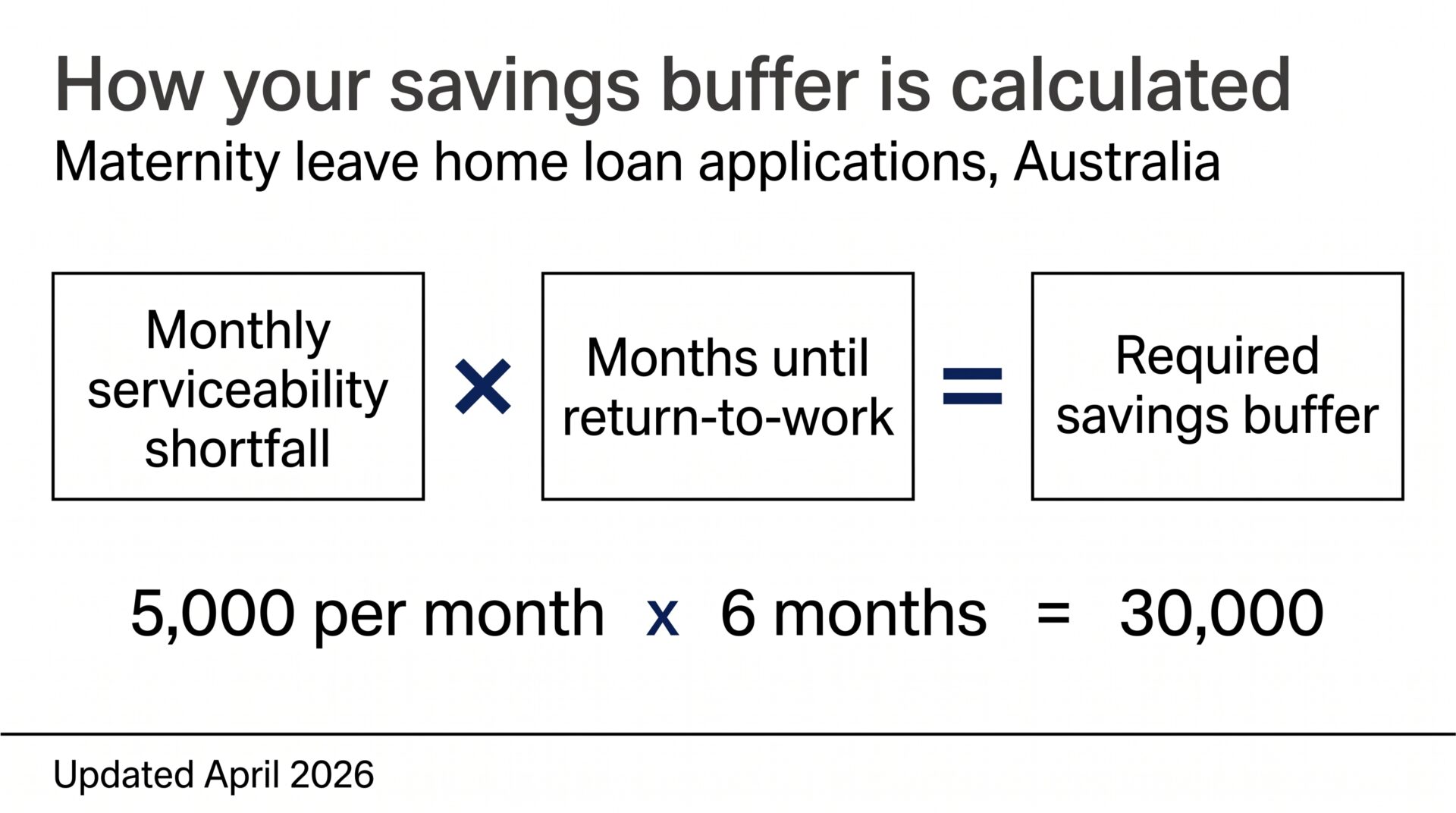
The buffer is the monthly shortfall multiplied by the number of months between settlement and your return date. It sits on top of your deposit, stamp duty and costs, not inside them, and it can be savings or accessible funds such as an offset or redraw balance in the applicants’ names.
A worked example, with round numbers to show the method:
- The lender’s two calculations show the household is $5,000 a month short while you’re on leave.
- You settle with 6 months to go before your return date.
- Buffer required: $5,000 x 6 = $30,000, held separately from the deposit.
Now say you’ll receive $1,500 a month of employer-paid leave for three of those six months. A lender that lets confirmed in-leave income offset the buffer might cut the requirement to $25,500 ($30,000 less $4,500). A lender that doesn’t will still want the full $30,000. Roughly half the approach A lenders on our panel allow that offset.
Most lenders also offer interest-only periods under their normal product rules, and a short one to cover the leave is the example ASIC’s own responsible lending guide uses. Keep it to the leave period and no longer.
Two things follow. The closer you settle to your return date, the smaller the buffer. And the buffer is often what decides the timing of a purchase, not the loan amount.
Your partner’s income
In a two-income household, your partner’s salary does most of the work during your leave. It can’t be counted twice, though. If both incomes are already used to size the loan, your partner’s income is fully committed to the repayments and can’t also cover your shortfall. That’s how most lenders on our panel run it: the household’s combined surplus during your leave, with your partner’s income already committed to the repayments. A few are stricter about how shared household expenses are split.
If your income during leave isn’t enough, your partner’s income alone has to carry the loan. That’s normal joint-application arithmetic, not a separate policy.
What your return-to-work letter must say for a home loan
This one document decides more of these applications than anything else. A vague letter (“will return at a later date”) gets sent back. Ask your employer for a signed letter on company letterhead that states:
- your role and how long you’ve worked there
- the date your leave started and your confirmed return date
- whether you return full-time or part-time, with hours or days per week
- your gross salary on return (the part-time figure if you’re going back part-time)
- the name, title and contact details of the person signing
Many lenders want it on company letterhead, signed, with the employer’s ABN, and dated within the last 60 days; a few want it under 30 days, so aim for that. Several will ring the signatory to confirm it, so warn your employer that a call may come, and a few also ask the employer to confirm your position is being held open.
If you’re going back part-time, the part-time salary is the income that gets assessed, so check the number before you ask for the letter. Every lender on our panel uses the part-time figure.
Documents to have ready
On top of the letter, expect to provide:
- your last two payslips from before your leave started
- your most recent payslip, if you’re still receiving employer-paid leave
- evidence of any other income during leave, such as a Parental Leave Pay statement from Services Australia
- bank statements showing the savings buffer, separate from your deposit
- the standard items: ID, expenses, debts and credit limits
Our home loan application document checklist covers the standard list in full.
Do you have to tell the lender you’re pregnant?
Yes, in practice. Lenders and brokers have to ask about changes to your income you can reasonably foresee, and you need to answer truthfully. ASIC’s responsible lending guide (RG 209) says the assessment needs information about your income and “changes that are reasonably foreseeable”. A planned period of parental leave is exactly that. ASIC’s own worked examples include a borrower whose partner is returning to work after maternity leave, with the return date verified by her employer.
The law cuts the other way too. Under section 22 of the Sex Discrimination Act 1984, a lender can’t refuse you, or offer you worse terms, because you’re pregnant. What it can do, and must do, is check that you can afford the loan through the drop in income. If you believe a decline was about the pregnancy and not the numbers, you can make a complaint to the Australian Human Rights Commission.
Applying for a mortgage before, during or after your leave
Before. Your full salary is on your payslips, which makes this the simplest file. But if your leave is planned you’ll be asked about it, and most lenders on our panel will treat you as if you’re already on leave when it starts within about three months of settlement, so expect to need the letter and the buffer anyway. Pre-approvals also expire, and a pregnancy plus a property search can outlast one.
During. Workable with a firm return-to-work letter and a buffer, especially if you’re returning full-time and your return date isn’t far off. Expect more questions and more paperwork.
After. A few payslips at your new arrangement make the strongest file. If your return date or hours are still undecided, this is usually the only realistic path, because your employer can’t write the letter yet. Going back casual or to a new employer is its own question: expect lenders to want you back at work with about three months of payslips before they’ll count the income. Our guide to home loans on casual employment covers what lenders look for if you’re going back casual.
Whichever you choose, get pre-approval before you sign a contract. A leave file is more complex, and you want the number before you fall for a house.
First home buyers, refinancers and guarantors
First home buyers
A small deposit and a leave period together can narrow the field of lenders. Check the first home buyer options first, because some concessions change how much deposit you need.
Refinancing
Refinancing while on leave works on the same evidence as a purchase. A handful of lenders on our panel go easier on a like-for-like refinance with no extra borrowing, relying partly on your repayment history. Any cash-out or top-up is assessed like a purchase. Our refinancing page covers the standard refinance steps.
Guarantors
A family guarantee secures part of the loan against a parent’s property. It can remove the need for lenders mortgage insurance on a small deposit, which matters if you’re buying on one income while on leave. In our experience it’s mostly a major-bank product, so choosing it also narrows the lender list. See how a guarantor home loan works.
Why your bank’s “no” isn’t the market’s answer
A decline from your own bank tells you that bank’s policy. It doesn’t tell you whether you can borrow. The couple in our refinance example had nothing wrong with their file. They’d asked a lender whose rules didn’t fit it.
When we look at a leave file, the first question isn’t the rate. It’s which approach each lender takes to your income, how far away your return date is, and whether your savings cover the gap. Get those three right and the rest of the application is ordinary.
Frequently asked questions
Can you get a home loan while on maternity leave?
Yes. We place these loans regularly when your employer confirms in writing when you’re returning and what you’ll earn, and you can show savings to cover the gap in repayments until then. Policies differ widely between lenders, so the lender you apply with matters as much as your numbers.
Will being on maternity leave affect getting a mortgage?
It affects how your income is assessed, not whether you can apply. A lender can’t refuse you because you’re pregnant, but it must check you can afford the loan through a period of lower income. Expect to provide a return-to-work letter and show a savings buffer, and expect your borrowing power to reflect a new dependant.
Do I have to tell my lender I’m pregnant or going on leave?
Yes, in practice. Responsible lending rules require lenders and brokers to ask about changes to your income that are reasonably foreseeable, and planned parental leave is one, so answer truthfully. Pregnancy itself can’t be a reason to refuse you under the Sex Discrimination Act 1984.
Do lenders count Parental Leave Pay as income?
Yes, at most lenders. Most lenders on our panel count Government Parental Leave Pay as income for the loan itself, usually at its full amount, and a few shade it to 50% or 90%. For lenders using your return-to-work salary, it typically reduces the savings buffer you need to show rather than being counted as a separate income stream. It is $1,004.70 per 5-day week before tax for days taken in 2026-27, for up to 26 weeks per family if your child was born or adopted from 1 July 2026. Treatment varies from lender to lender.
Can I get a home loan on Centrelink payments?
Some payments can count. At least one lender on our panel accepts Family Tax Benefit A and B as income. Parental Leave Pay is a separate question because it stops after 26 weeks. Which payments count, and at what rate, depends on the lender.
How much savings do I need while on maternity leave?
Enough to cover your monthly shortfall for every month between settlement and your return date, on top of your deposit and costs. If the household is $5,000 a month short and you settle 6 months before you return, that is a $30,000 buffer. Some lenders reduce it for employer-paid leave you’ll receive during that time.
What should a return-to-work letter for a home loan say?
Your role and length of service, the date your leave started, your confirmed return date, whether you return full-time or part-time with your hours, and your gross salary on return. Many lenders want it on company letterhead, signed by someone with authority with their contact details, with the employer’s ABN, and dated within the last 60 days; a few want it under 30 days, so aim for that. Several will ring the signatory to confirm it, and a few also ask the employer to confirm your position is being held open.
Can I refinance while on maternity leave?
Yes, with a lender whose policy accepts your return-to-work income. The evidence is the same as for a purchase: a return-to-work letter, your payslips from before leave, evidence of any leave payments and savings to cover the gap.
Is it discrimination if a bank declines me because I’m on maternity leave?
Refusing you because you’re pregnant is unlawful under section 22 of the Sex Discrimination Act 1984. Declining because the numbers don’t show you can afford the loan through your leave is the lender meeting its responsible lending obligations. If you think a decline was the first kind, you can complain to the Australian Human Rights Commission.
Talk to us before you apply
If you’re on leave, or about to be, and want to know where your file would land, send us an enquiry or call (02) 8004 7459 for a 15-minute chat. We’ll look at your return date and your savings, and tell you which of the approaches above fits your file. It’s usually a short conversation, and it can save you a declined application and an extra enquiry on your credit file.
This article contains general information only and does not constitute financial advice. Your personal financial situation, objectives and needs have not been considered. Before acting on any information, you should consider its appropriateness to your circumstances. Speak to a qualified mortgage broker for advice tailored to your situation. Mortgage World Australia Pty Ltd is a credit representative (CR No. 396946) of Mortgage Specialists Pty Ltd (Australian Credit Licence No. 387025).

Patrick is a Director and a Home Loan Specialist. He has been helping Australians with home loans since 2001. Prior to working as a mortgage broker Patrick was employed by Macquarie Bank for 3 years and also worked as an accountant for a publicly listed company. Patrick’s qualifications include:
Bachelor of Business, UTS Sydney. Majored in accounting and sub-majored in Finance and Marketing.
Diploma of Finance and Mortgage Broking Management FNS50310
Certificate IV in Financial Services (Finance/Mortgage Broking) FNS40804
Ready to Take the Next Step?
Whether you’re looking to buy your first home, refinance, or explore investment opportunities, Mortgage World Australia is here to help.
Fill out the contact form below, and one of our expert mortgage brokers will be in touch shortly to discuss your needs and guide you through your options.
Get Started Today!