

LMI Waivers for Nurses and Healthcare Workers (2026)
LMI Waivers for Nurses and Healthcare Workers: 2026 Guide
On this page ▾
- What an LMI waiver is, and what it is worth to a nurse
- Which lenders waive LMI for nurses in 2026
- Which healthcare roles qualify for an LMI waiver?
- How much can you save by skipping LMI?
- Should you take the LMI waiver or the federal 5% Deposit Scheme?
- When an LMI waiver is not the right move
- Part 2: home loans for healthcare workers, with or without an LMI waiver
- The application process step by step
- Frequently asked questions
By Patrick O’Brien, Director and Home Loan Specialist since 2001
Most articles about home loans for nurses come from a single bank’s product page or from a niche specialist with a reason to push you toward one outcome. This one comes from a broker with access to 52+ lenders, and it tells you something the bank pages don’t: only one of the big four banking groups waives Lenders Mortgage Insurance (LMI) for registered nurses, and it sets an income test. The other nurse waivers sit with a handful of smaller lenders, and each one has its own rules.
This guide is in two parts, because they answer different questions:
- Part 1: LMI waivers. Which lender policies cover nurses, midwives, paramedics and other health workers, and on what terms.
- Part 2: home loans for healthcare workers in general. Income evidence, shift allowances and overtime, which apply whether or not you qualify for a waiver.
If your role is not eligible for a waiver, you can still get a home loan, and first home buyers may be able to avoid LMI another way through the government’s 5% Deposit Scheme.
What an LMI waiver is, and what it is worth to a nurse
Lenders Mortgage Insurance (LMI) applies when you borrow more than 80% of a property’s value. The borrower pays the premium, but the policy protects the lender if you default. Most lenders add the premium to the loan, so you also pay interest on it for as long as the loan runs.
An LMI waiver means the lender agrees not to charge that premium, even though you are borrowing more than 80%. On an $800,000 purchase with a 10% deposit (a $720,000 loan at 90% LVR), that typically removes somewhere around $12,000 to $17,000. A waiver is not an exemption, though. You still need to pass the lender’s serviceability test, prove your registration and stay inside the lender’s loan-size and property limits.
Which lenders waive LMI for nurses in 2026
We have checked the policies across our panel. Five lenders currently offer an LMI waiver that registered nurses can use, only one of them a big four banking group, and their conditions differ a lot. The table below sets out each one alongside the government scheme. Lender policy changes often, so we confirm the current terms before you apply.
| Waiver | Who it covers | Max LVR without LMI | Key conditions |
|---|---|---|---|
| Major-bank medico waiver (one big four banking group) | Registered nurses and midwives, plus a named list of allied health, pharmacy, optometry and vet professions | 90% | At least $90,000 a year from the eligible profession (combined where both applicants qualify). Loans up to $5 million. Principal and interest, or interest-only that converts to principal and interest. No exceptions for roles not on the list |
| Essential services package (one lender) | Registered nurses, fully qualified paramedics and sworn police officers. Midwives are not listed | 90% | Loans up to $1.2 million; principal and interest only; owner-occupied or investment, purchase or refinance. Income of at least $80,000 for a single applicant, or $150,000 combined with the eligible applicant earning at least $75,000. Permanent or fixed-term employment, not casual or probationary |
| Essential-worker waiver (one lender) | Permanently employed nurses, paramedics, police officers, firefighters and school teachers | 90% | Buying an established home to live in only: no construction, refinance or investment. The eligible worker must be the main income earner |
| Select-professions waiver (one lender) | Health practitioners registered with the relevant national board, including the Nursing and Midwifery Board and the Paramedicine Board | 90% | Assessed case by case. Owner-occupied, principal and interest, including construction. At least three years’ experience and at least half your assessable income from the profession |
| Member-bank waiver for health workers (one lender) | Health workers, and police and emergency services workers | 90% | Owner-occupied only; for health workers, purchases only. Membership rules apply, so we confirm the current terms directly |
| Australian Government 5% Deposit Scheme (via a participating lender) | First home buyers in any occupation | 95% (5% deposit) | First home buyers (5% deposit) or single parents and legal guardians (2%), owner-occupier, under the property price cap |
| Other big four professional packages | Doctors, specialists and dentists, and pharmacists and optometrists at one. Not nurses | n/a for nurses | Built for medical, legal and accounting professions |
The major-bank medico waiver
One big four banking group runs a medico waiver with two tiers. Doctors, specialists and dentists sit in the top tier at up to 95%. Registered nurses and midwives sit in the second tier, alongside a named list of allied health, pharmacy, optometry and vet professions, at up to 90% of the property value without LMI. The key test is income: you need at least $90,000 a year from your nursing or midwifery work, and other income such as rent cannot count towards it. Where both applicants are eligible, their income from the profession is combined. Loans go up to $5 million, repayments can be principal and interest or interest-only that converts to principal and interest, and the lender does not make exceptions for roles or incomes outside the policy. Enrolled nurses are not on the list.
The essential services package
This is the most flexible of the smaller-lender nurse waivers on loan purpose. It covers owner-occupied and investment loans, purchases and refinances. The trade-offs are a $1.2 million loan cap, principal-and-interest repayments only, an income test and a cap on how much equity you can release. It names registered nurses, so enrolled nurses and midwives miss out. For a couple, only one of you needs to be the eligible worker, provided that person earns at least $75,000 and your combined income is at least $150,000.
The essential-worker waiver
This one is simple to qualify for if you fit it: you must be a permanently employed nurse, paramedic, police officer, firefighter or school teacher, and the main income earner on the application. The catch is the loan purpose. It only covers buying an established home you will live in, so building, refinancing and investing are all out.
The select-professions waiver
This lender’s policy is written around professional registration rather than job title. It covers practitioners registered with the national boards, including the Nursing and Midwifery Board and the Paramedicine Board, so it covers midwives as well as registered nurses. It is assessed case by case. You need at least three years’ experience in the profession, and at least half your assessable income has to come from it. It covers owner-occupied, principal-and-interest loans, including construction.
Member-bank waivers for health workers
One member-owned bank waives LMI up to 90% for health workers buying a home to live in, and for police and emergency services workers on purchases or refinances. Membership rules apply, and it publishes fewer details than the others, so this is one we check directly for each client.
Where the big four stand
One big four banking group waives LMI for registered nurses and midwives, as set out above. The other three do not. Their professional packages are built for doctors, specialists and dentists, plus accountants and lawyers, and at least one explicitly lists nurses, midwives, pharmacists and several allied health professions as ineligible.
Which healthcare roles qualify for an LMI waiver?
“Healthcare worker” covers a huge range of jobs, and the waivers are drawn narrowly. Here is where each role sits against the lenders on our panel:
| Role | LMI waiver options |
|---|---|
| Registered nurse, including nurse practitioners | All five nurse waivers above, each with its own conditions |
| Enrolled nurse | Generally not eligible. The nurse waivers are written for registered nurses, so enrolled nurses usually miss out. The 5% Deposit Scheme or a family guarantee is the better route |
| Midwife | Two lenders: the major-bank medico waiver ($90,000 a year from midwifery) and the select-professions waiver. Not the essential services package |
| Paramedic | Four smaller lenders: the essential services package (fully qualified paramedics), the essential-worker waiver (permanent roles), the select-professions waiver (Paramedicine Board) and the member bank (emergency services) |
| Doctor, specialist or dentist | Most lenders with a waiver, including the big four, up to 90% and at some lenders 95%. See our LMI waivers hub |
| Pharmacist, optometrist or vet | Several lenders, but coverage differs. One big four banking group covers all three with a $90,000 income test, another covers pharmacists (with a $100,000 income test) and optometrists but not vets, and two of the big four cover none of them |
| Physiotherapist, psychologist, occupational therapist, podiatrist, chiropractor, osteopath or radiographer | Two lenders: the major-bank medico waiver names each of these, with a $90,000 income test from the profession, and the select-professions waiver covers them case by case. Other big four programs exclude them |
| Sonographer, audiologist or speech pathologist | One lender: the major-bank medico waiver names these professions, with a $90,000 income test from the profession |
| Enrolled nurse, assistant in nursing, hospital support staff, or allied health roles not named above (such as dietitians, exercise physiologists and social workers) | Generally no waiver. The major-bank list makes no exceptions for roles it does not name |
If you are in a role with no waiver, or you are casual, paying LMI is not your only option. First home buyers in any role can use the Australian Government 5% Deposit Scheme, and a family guarantee works for anyone with family able to help. Both are covered below.
How much can you save by skipping LMI?
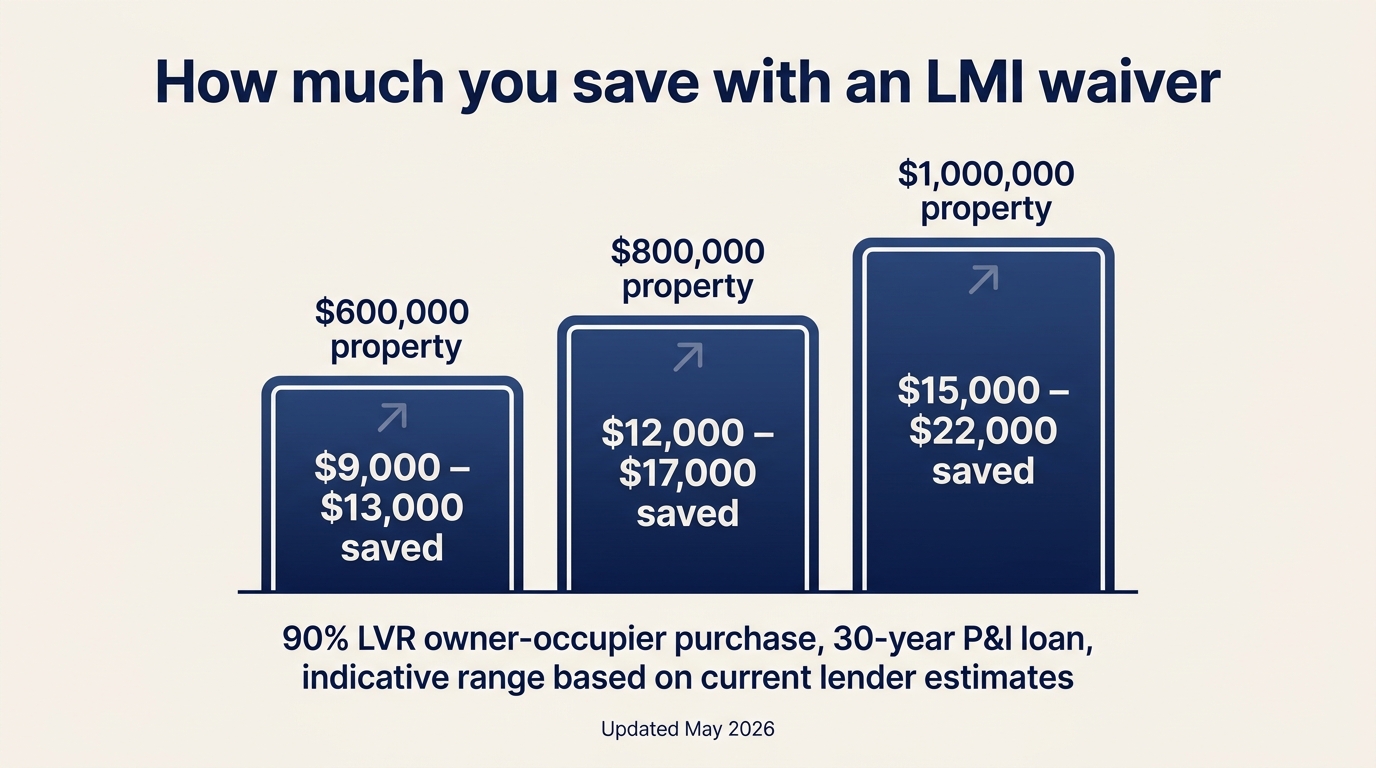
The dollar savings on an LMI waiver move with the property price, the deposit size, and which LMI provider the lender uses. Here is an indicative comparison for a 10% deposit, owner-occupier, 30-year principal-and-interest loan, based on current Helia and lender-internal LMI estimates for an owner-occupier first home buyer profile:
| Property price | Loan amount (90% LVR) | Indicative LMI premium | Saving with a waiver |
|---|---|---|---|
| $600,000 | $540,000 | $9,000 to $13,000 | $9,000 to $13,000 |
| $800,000 | $720,000 | $12,000 to $17,000 | $12,000 to $17,000 |
| $1,000,000 | $900,000 | $15,000 to $22,000 | $15,000 to $22,000 |
These are indicative only. Premiums vary between LMI providers, and most lenders add the premium to the loan, so the long-run interest cost is higher than the headline. We can run a precise comparison once we know the lender and your borrower profile.
Should you take the LMI waiver or the federal 5% Deposit Scheme?
This is the most common question we get from healthcare workers buying their first home. The two pathways are alternatives, not additives. There is only one LMI premium on a loan, so you avoid it one way or the other.
The Australian Government 5% Deposit Scheme (formerly the Home Guarantee Scheme) lets eligible first home buyers purchase with a 5% deposit, and eligible single parents and legal guardians with 2%, with no LMI, because the government guarantees part of the loan. Since 1 October 2025 there are no income caps or waitlists. It applies property price caps: $1,500,000 in Sydney and the NSW regional centres and $800,000 elsewhere in NSW, $950,000 in Melbourne and Geelong, $1,000,000 in Brisbane, the Gold Coast and the Sunshine Coast, and $1,000,000 in the ACT, with lower caps in other areas. First home buyers in NSW may also be exempt from stamp duty on a home under $800,000. See our guide to NSW stamp duty exemptions.
The scheme has one big advantage: it does not depend on your job. Enrolled nurses, assistants in nursing, casual staff and anyone else whose role misses out on a waiver can use it if they meet the scheme’s criteria and the lender’s normal lending criteria.
A nurse choosing between the two is really weighing deposit size, the property price against the scheme cap, and what the loan is for. The scheme is usually the better fit when you have a 5% deposit and the property is inside the cap. A waiver can be the better fit when you have 10%, the property is above the cap, you are not a first home buyer, or you need a feature only a waiver lender offers, such as an investment loan or a refinance.
When an LMI waiver is not the right move
LMI waivers are a big saving for the right borrower, but they are not always the right tool. We sometimes steer healthcare workers away from one:
- The loan is too big for the waiver. One nurse waiver caps the loan at $1.2 million, and the others have their own limits.
- The income test does not fit. A part-time nurse on $70,000 would miss both the $80,000 and $90,000 income tests, and might do better through the 5% Deposit Scheme.
- The purpose does not fit. Several nurse waivers are for a home you will live in only, and one covers established homes only. For investment property loans, the rate and structure often matter more than the waiver.
- You are already under 80% LVR. If you are refinancing with at least 20% equity, there is no LMI to waive, and the conversation is about rate, structure and how a lender treats your shift income.
There is also a lock-in to weigh. When you borrow at around 90%, you are effectively tied to that lender until your equity grows past 20%, because refinancing away at a high LVR would usually mean paying LMI to the new lender. If the waiver lender’s ongoing rate is not competitive, a higher rate can eat into the premium you saved. A family guarantee, where a parent uses equity in their home as extra security, avoids LMI and gets you the lower sub-80% rates at the same time, and it can beat a waiver outright.
Part 2: home loans for healthcare workers, with or without an LMI waiver
From here on, this guide is about getting a home loan approved, not about LMI waivers. Lenders lend to healthcare workers in every kind of role, including the roles that do not qualify for a waiver. Being approved for a loan and qualifying for a waiver are separate questions: the sections below affect how much you can borrow, not whether LMI is waived.
Where most healthcare applications stall is income evidence. Hospital-employed nurses typically have four income components: base salary, shift allowances, overtime and casual loadings, and lenders treat each one differently.
Base salary, payslips and income statements
The standard documentation is two recent payslips showing your year-to-date income, and your latest income statement or Notice of Assessment. Permanent full-time and permanent part-time roles are the easiest cases. Lenders typically want to see at least three to six months in the role with the same employer.
Casual, part-time and multi-employer nursing income
Casual nursing income is the most common pain point, and lender practice varies. Most lenders look for 12 months of continuous casual employment in the same role or industry, though some accept six months for healthcare workers. Casual loading is included in assessable income once the pattern is ongoing. Nurses working across more than one employer, such as a public hospital and a private one, need payslips from each employer and a steady pattern of shifts. Keep in mind that the nurse LMI waivers generally require permanent or fixed-term employment, so a casual nurse can often get the loan but may still pay LMI above 80% LVR. For how lenders annualise casual income and the tenure each one wants, see our casual employment home loan guide.
Agency and locum nursing income
Agency and locum income is treated as a hybrid of casual and contract income. Some lenders want 24 months of agency history, while others accept 12 months of continuous payslips from the agency. If you are a locum nurse, talk to a broker before you apply, because the differences between lenders are large enough to change which lender is the right fit.
Shift allowances and overtime
Lenders differ a lot here. Some count 100% of regular overtime and shift allowances for frontline health and emergency workers once there is enough history, usually a few months to a full financial year of payslips with the same employer. Others shade overtime and allowances to 80% or less. For shift workers, who often earn a large share of their income in allowances, that difference can change your borrowing capacity by tens of thousands of dollars.
Borrowing capacity is a serviceability calculation, not a salary multiple. The lender takes your income, subtracts your living expenses and existing debts at a stress-tested interest rate, and lends against what is left. Banks regulated by APRA add a 3% buffer to the interest rate, and some non-bank lenders use a smaller one. Matching the right treatment of your shift income to the right lender is what unlocks borrowing capacity, not just hunting for the lowest rate.
The application process step by step
Most healthcare home loan applications take four to six weeks from pre-approval to settlement, but the front end is where the work happens.
Registration evidence (if you are applying for a waiver)
Lenders check eligibility for a health-worker waiver against the AHPRA public register. You will need your registration number, and the lender will confirm your registration is current. For the select-professions waiver, you will also need to show at least three years’ experience. Have a recent copy of your AHPRA registration record on hand.
Documents to gather before pre-approval
Standard documents include two recent payslips, your latest income statement or Notice of Assessment, three months of bank statements covering your transaction and savings accounts, identification, and evidence of genuine savings. If you have shift allowances or overtime, ask your employer for a year-to-date letter confirming the pattern.
Pre-approval to settlement timeline
Pre-approval typically takes one to two weeks once the documents are submitted. Once you have an accepted contract, formal approval takes another two to three weeks while the lender values the property and confirms the loan terms. Settlement follows the contract date, commonly around six weeks after exchange. If you are using a waiver, allow a little extra time for the lender to verify your registration.
The right pathway is borrower-specific. We see healthcare workers across our panel every week, and matching the right lender to the right income profile is what we do all day. If you are trying to work out which option fits, call us on (02) 8004 7459 and we will work through it with you.
Frequently asked questions
Do nurses get cheaper home loans? Sometimes. An eligible nurse can access an LMI waiver, which on a 90% LVR purchase of $600,000 to $1,000,000 (a $540,000 to $900,000 loan) typically removes somewhere around $9,000 to $22,000 of LMI. Some lenders also offer professional-package rate discounts for healthcare workers, but the discount is usually worth less than the LMI saving.
Are nurses exempt from LMI? No. Nurses are not exempt from LMI. A handful of lenders waive the premium for eligible nurses at up to 90% LVR, and each sets its own conditions, such as loan caps, income tests, and limits on what the loan can be used for.
Which banks waive LMI for nurses? On our panel, five lenders currently offer a waiver registered nurses can use. One is a big four banking group, which waives LMI up to 90% for registered nurses and midwives earning at least $90,000 a year from the profession. The others are an essential services package, an essential-worker waiver for permanently employed nurses buying an established home to live in, a select-professions waiver for nurses and midwives with three years’ experience, and a member bank’s waiver for health workers. First home buyers can also avoid LMI through the Australian Government 5% Deposit Scheme.
Can enrolled nurses get an LMI waiver? Generally not. The nurse LMI waivers are written for registered nurses, so enrolled nurses usually do not qualify. Enrolled nurses who are first home buyers can still avoid LMI through the Australian Government 5% Deposit Scheme, which does not depend on your job, and a family guarantee is another option.
Can midwives get an LMI waiver? Yes, at two lenders on our panel. One big four banking group waives LMI up to 90% for midwives earning at least $90,000 a year from midwifery. A select-professions waiver also covers practitioners registered with the Nursing and Midwifery Board, with at least three years’ experience and at least half their income from the profession. The essential services package does not list midwives.
How much deposit do nurses need? With an LMI waiver, an eligible nurse can buy with a 10% deposit (90% LVR) and pay no LMI. With the Australian Government 5% Deposit Scheme, an eligible first home buyer needs a 5% deposit. Without either, you need a 20% deposit to avoid LMI. Either way, you also need to cover costs such as stamp duty.
What salary do you need for a $500,000 loan? Borrowing capacity is a serviceability calculation, not a salary multiple. As a rough guide, a single applicant with no other debts and modest living expenses typically needs $80,000 to $100,000 of gross income to qualify for a $500,000 loan, but the exact figure depends on the lender’s stress buffer, the interest rate and the household’s expenses. Healthcare workers with regular overtime and allowances can often borrow more than their base salary suggests, at lenders that count that income in full.
How much do you need to earn for a $700,000 mortgage? On the same broad principles, a $700,000 mortgage typically needs around $115,000 to $140,000 of gross income for a single applicant with no other debts, and less per applicant for a joint application where both incomes count. How a lender treats your shift allowances and overtime matters most at this loan size, which is where choosing the right lender pays off.
This article contains general information only and does not constitute financial advice. Your personal financial situation, objectives and needs have not been considered. Before acting on any information, you should consider its appropriateness to your circumstances. Speak to a qualified mortgage broker for advice tailored to your situation. Mortgage World Australia Pty Ltd is a credit representative (CR No. 396946) of Mortgage Specialists Pty Ltd (ACN 612 422 178, Australian Credit Licence No. 387025). Patrick O’Brien is a Credit Representative (396946) of Mortgage Specialists Pty Ltd (ACN 612 422 178, Australian Credit Licence No. 387025).

Patrick is a Director and a Home Loan Specialist. He has been helping Australians with home loans since 2001. Prior to working as a mortgage broker Patrick was employed by Macquarie Bank for 3 years and also worked as an accountant for a publicly listed company. Patrick’s qualifications include:
Bachelor of Business, UTS Sydney. Majored in accounting and sub-majored in Finance and Marketing.
Diploma of Finance and Mortgage Broking Management FNS50310
Certificate IV in Financial Services (Finance/Mortgage Broking) FNS40804
Ready to Take the Next Step?
Whether you’re looking to buy your first home, refinance, or explore investment opportunities, Mortgage World Australia is here to help.
Fill out the contact form below, and one of our expert mortgage brokers will be in touch shortly to discuss your needs and guide you through your options.
Get Started Today!