

Home Loans for Teachers: LMI Waivers and Options in 2026
Home Loans for Teachers: LMI Waivers and Options in 2026
On this page ▾
- What an LMI waiver means for teachers
- What is 90% no LMI for teachers?
- Where teachers can get LMI waived in 2026
- Which teachers are eligible for an LMI waiver?
- How much can a teacher save with an LMI waiver?
- LMI waiver or the 5% Deposit Scheme: which is better for you?
- Teachers vs other professions: when your job changes the deal
- When an LMI waiver is not the right move
- Part 2: home loans for teachers, with or without an LMI waiver
- How to apply: from pre-approval to settlement
- Frequently asked questions
By Patrick O’Brien, Director and Home Loan Specialist since 2001
A home loan for teachers can come with an advantage most borrowers never get offered: a lender waiving Lenders Mortgage Insurance (LMI), the one-off premium that normally applies when you borrow more than 80% of a property’s value. For a teacher buying with a smaller deposit, that waiver can be worth tens of thousands of dollars. The catch is that very few lenders offer it, the eligibility rules are narrow, and your own bank has no reason to tell you a different lender would treat your profession better.
A single bank only sells its own book. Over 25 years we have moved clients that one lender had effectively written off, because we knew which lender’s policy fitted their exact situation. Teachers are one of the professions where that cross-lender knowledge pays off.
This guide is in two parts, because they answer different questions:
- Part 1: LMI waivers for teachers. Who can borrow up to 90% of a property’s value without paying LMI. Only two lenders on our panel offer this to teachers, and both are written for registered school teachers who meet their conditions.
- Part 2: home loans for teachers in general. How lenders assess teaching income. This applies to every teacher and education worker, whether or not you qualify for a waiver.
If your role is not eligible for a waiver, you can still get a home loan, and first home buyers may be able to avoid LMI another way through the government’s 5% Deposit Scheme.
What an LMI waiver means for teachers
LMI is an insurance premium that protects the lender, not you, if you cannot repay the loan. It kicks in when your Loan-to-Value Ratio (LVR), the amount you borrow divided by the property’s value, goes above 80%. So on an $800,000 purchase, borrowing more than $640,000 normally triggers LMI.
A waiver means the lender agrees not to charge that premium even though you are above 80% LVR. For an eligible teacher, the practical effect is that you can buy with a 10% deposit and skip a cost that would otherwise be added to your loan. It is the same category of benefit that doctors and other professionals have enjoyed for years, extended to school teachers by a small number of lenders. For the fuller mechanics, see our guide to LMI waivers and no-LMI home loans.
One thing to keep clear from the start: a waiver only matters above 80% LVR. If you have a 20% deposit, there is no LMI to waive, and the conversation shifts to rate and structure instead.
What is 90% no LMI for teachers?
“90% no LMI” means a lender lets an eligible teacher borrow up to 90% of the property value, a 10% deposit, without charging LMI. Because LMI normally applies on anything above 80% LVR, the waiver removes a premium that can run to tens of thousands of dollars on a metropolitan purchase. It is the most valuable concession in teacher lending, and it is real, though narrower than some marketing suggests.
Here is a worked example. A teacher buys an $800,000 home with an $80,000 deposit and borrows $720,000. That is 90% LVR, comfortably above the 80% line, so LMI would normally apply. With a lender that waives LMI for that teacher at 90%, the premium is removed entirely. The deposit and loan still reconcile to the purchase price, and the only thing that changes is the premium you avoid.
You will see some lenders and brokers advertise 95% no LMI. Be careful with that number. The teacher waivers on our panel cap the no-LMI benefit at 90% LVR. A 95% figure usually refers either to general borrowing capacity with LMI still payable, or to the separate government deposit scheme covered further down, not to a teacher LMI waiver.
Where teachers can get LMI waived in 2026
No single lender owns the teacher market, which is exactly why comparing across the panel matters. The table below sets out the routes to avoiding LMI, based on lender policy at the time of writing. Lender policy changes often, so we confirm the current terms with each lender before you apply.
| Route | Who it covers | Max LVR without LMI | Key conditions |
|---|---|---|---|
| Essential-worker LMI waiver (one lender on our panel) | Permanently employed primary or secondary school teachers, public or private | 90% | Buying an established home to live in only: no construction, refinance or investment. The teacher must be the main income earner |
| Select-professionals LMI waiver (one lender on our panel) | Teachers who hold valid state teacher accreditation | 90% | Owner-occupied, principal and interest, including construction. At least three years’ teaching experience and at least half your assessable income from teaching |
| Australian Government 5% Deposit Scheme (via a participating lender) | First home buyers in any occupation | 95% (5% deposit) | First home buyers (5% deposit) or single parents and legal guardians (2%), owner-occupier; NSW price cap $1,500,000 in Sydney and regional centres, $800,000 elsewhere |
| Major-bank professional packages | Generally not teachers | n/a for teachers | Aimed at medical, legal and accounting professions |
The two teacher LMI waivers on our panel
The essential-worker waiver. One lender includes teachers in its essential-worker policy, alongside nurses, paramedics, police and firefighters. Its wording is specific: you must be a permanently employed primary or secondary school teacher, in either the public or the private system. The waiver goes up to 90% of the property value and only applies to buying an established home you will live in, so construction loans, refinances and investment purchases are out. The teacher also needs to be the main income earner on the application.
The select-professionals waiver. The other lender offers no-LMI loans up to 90% to a list of accredited professions that includes teachers. Here the test is registration: you must hold valid state-based teacher accreditation (in NSW, that is accreditation with NESA). It covers owner-occupied, principal-and-interest loans, including construction loans, and you need at least three years’ experience in teaching and at least half your assessable income coming from it.
Education-sector member banks
You will also see member-owned banks set up for people who work in education marketing directly to teachers. Any single bank, however good, can only offer you its own product. It cannot tell you that a different lender might waive your LMI on terms that suit you better, or that the government scheme could beat its in-house offer for your situation. That is not a criticism of the bank; it is just the shape of a single-lender relationship.
Major and tier-2 lenders: where teachers stand
This is the part many teacher guides gloss over. The classic professional-package LMI waivers that the major banks and their subsidiaries offer are aimed at medical, dental, legal and accounting professionals, sometimes with income tests of $100,000 or more. Teachers are generally not on those lists. One major-bank brand expanded its waiver list this year to cover technology, banking and some federal government roles, and teachers still are not on it.
So for teachers, the reliable no-LMI routes are one of the two teacher waivers above, if you qualify, or the government deposit scheme. A major bank is still often the right home for a teacher’s loan on rate and features, just not usually via an LMI waiver.
Maximum LVR and income tests
Both teacher waivers cap out at 90% LVR, so a 10% deposit, with no LMI. Neither policy states a dollar minimum income. The tests are about your role (a permanently employed or accredited school teacher), what the loan is for, how long you have been teaching and how much of your income comes from teaching. Because these policies move, treat this as a starting point and let us confirm the live policy before you commit.
Which teachers are eligible for an LMI waiver?
This is where most of the confusion starts. “Teacher” covers a wide range of roles, but both waivers on our panel are written for school teachers. Most other education roles do not qualify for a waiver, even though they can usually still get a home loan (Part 2 covers that). Here is how each role sits against the two policies:
| Role | Essential-worker waiver | Select-professionals waiver |
|---|---|---|
| Permanent primary or secondary school teacher, public or private | Yes | Yes, with state teacher accreditation, three years’ experience and at least half your income from teaching |
| Principal or head of school | Not named in the policy; we confirm with the lender | Yes, with state teacher accreditation |
| Casual or relief teacher | No: permanent employment is required | Possibly: not excluded, but the three-year and income tests apply; we confirm with the lender |
| Fixed-term contract school teacher | Unlikely: the policy requires permanent employment | Possibly, with state teacher accreditation; we confirm with the lender |
| TAFE teacher | No: the policy covers school teachers only | Only if you hold state teacher accreditation, which many TAFE teachers do not |
| University lecturer or academic | No | Unlikely: academics generally do not hold state teacher accreditation |
| Early childhood educator | No | Unlikely: most early childhood educators do not hold state teacher accreditation |
| Teacher aide or education support staff | No | No: the waiver is for accredited teachers |
If your role sits in one of the “no” or “unlikely” rows, a waiver is probably off the table, but paying LMI is not your only option. First home buyers in any of these roles can use the Australian Government 5% Deposit Scheme, which depends on being a first home buyer rather than on your job, and a family guarantee works the same way for anyone. One lender can also put an unlisted profession to its credit team for approval case by case, so a borderline application, such as a TAFE teacher without state accreditation, can be worth submitting.
How much can a teacher save with an LMI waiver?
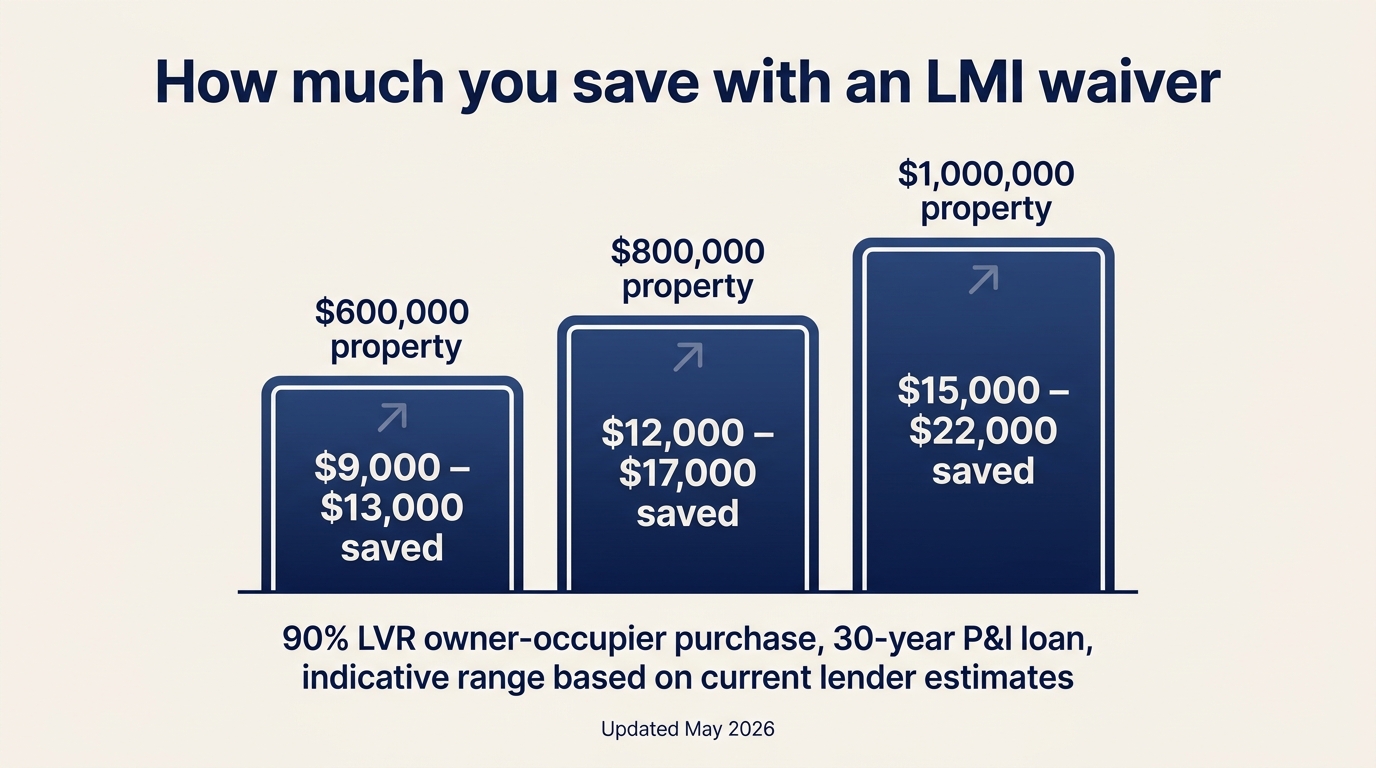
For a teacher who qualifies, the saving is the whole point, so let us put real figures on it. The table below shows an estimate of the LMI premium a first home buyer would otherwise pay at 90% LVR, based on current Helia premiums, which is what a waiver removes. Premiums vary by lender and insurer, so treat these as indicative rather than a quote. For the underlying method, see our explainer on how lenders mortgage insurance is calculated.
| Property value | Deposit (10%) | Loan (90% LVR) | Estimated LMI a waiver removes |
|---|---|---|---|
| $600,000 | $60,000 | $540,000 | ~$9,000 to $13,000 |
| $800,000 | $80,000 | $720,000 | ~$12,000 to $17,000 |
| $1,000,000 | $100,000 | $900,000 | ~$15,000 to $22,000 |
On a $1,000,000 purchase (a $900,000 loan at 90% LVR), the waiver removes roughly $15,000 to $22,000 that would otherwise be added to the loan and paid off with interest over the life of the mortgage. That is money that stays in the deal rather than going to an insurer. Even at the lower end, around $9,000 to $13,000 saved on a $600,000 home (a $540,000 loan at 90% LVR) is a meaningful head start.
LMI waiver or the 5% Deposit Scheme: which is better for you?
Teachers buying their first home can have two separate ways to avoid LMI, and this is the point most guides get muddled. They are alternatives, not a stack. There is only one LMI on a loan, so you avoid it one way or the other, not twice.
The first route is a lender LMI waiver, typically at 90% LVR with a 10% deposit, if your role qualifies. It is open to some non-first-home buyers too, and it carries no scheme price cap. The second route is the Australian Government 5% Deposit Scheme, where the government guarantees part of your loan so no LMI is charged, letting eligible first home buyers purchase with a 5% deposit, and eligible single parents and legal guardians with 2%. It is for owner-occupiers only, and it applies a property price cap. In NSW that is currently $1,500,000 in Sydney and the regional centres and $800,000 elsewhere, which covers most of Western Sydney comfortably. You can check the current thresholds on the government’s property price caps page, and the scheme is administered by Housing Australia.
The scheme has one big advantage for the education workers the waivers leave out: it does not depend on your job. Casual and relief teachers, TAFE teachers, early childhood educators and teacher aides can all use it if they meet the scheme’s criteria and the lender’s normal lending criteria.
Which is better comes down to your deposit and your goals. If you have only 5% saved and you are a first home buyer within the price cap, the scheme is usually the stronger option because it needs the smaller deposit. If you have 10%, qualify for a waiver and want to buy above the cap, or you are not a first home buyer, a lender waiver may suit you better. In our experience the scheme also does something people underrate: it protects your pricing. We have had buyers borrowing around 91% who, because they qualified for the scheme, kept a competitive rate they would not have secured on a standard high-LVR loan. First home buyers can weigh both routes with us on our first home buyers page. It is also worth checking your eligibility for first home buyer duty concessions, and for the First Home Owner Grant if you are buying or building new, through Revenue NSW.
Teachers vs other professions: when your job changes the deal
Teachers are one of several occupations that unlock better lending treatment, and seeing the wider picture helps you judge where you stand. Medical professionals can access LMI waivers up to 90% LVR (95% at some lenders), and accountants, lawyers and several other professions up to 90%. Our LMI waivers hub sets out which occupations qualify and on what terms, and we have separate guides for accountants and for nurses and healthcare workers, who sit alongside teachers in the essential-worker policy described above.
The lesson from comparing professions is not that one job is better than another. It is that the lender that waives LMI for a nurse is not always the one that does it for a teacher, and the conditions differ too. Knowing which lender’s policy matches your specific role is the practical value here, and it is why a view across 52+ lenders beats picking a single bank on brand alone.
When an LMI waiver is not the right move
Even when you qualify, there are times we steer teachers away from an LMI waiver. The most common is the high-LVR lock-in. When you borrow at around 90% with any lender, you are effectively tied to that lender until your equity grows past 20% (your LVR falls below 80%), because refinancing away at a high LVR would usually mean paying LMI to the new lender. If the waiver lender’s ongoing rate is not competitive, the saved premium can be eaten up by a higher rate over time.
There is often a better structure hiding in plain sight, too. A family guarantee, where a parent or in-law uses their property as security to cover the deposit shortfall, avoids LMI and unlocks the lower sub-80% interest rates at the same time. Many lenders offer it, the guarantee can be capped so the family’s exposure is contained, and the loan is assessed on your income, not the guarantor’s. For a teacher with family able to help, that can beat a 90% waiver outright, and it is open to education workers whose role does not qualify for a waiver. The right answer depends on your numbers, and working through them with you is what our Best Interests Duty as your broker requires.
Part 2: home loans for teachers, with or without an LMI waiver
From here on, this guide is about getting a home loan approved, not about LMI waivers. Lenders lend to teachers and education workers in every kind of role, including the roles that do not qualify for a waiver. Being approved for a loan and qualifying for a waiver are separate questions: the sections below affect how much you can borrow, not whether LMI is waived. For waiver eligibility, go back to the table in Which teachers are eligible for an LMI waiver?
Getting the income presentation right is where a lot of teacher applications are won or lost. Lenders are not just looking at the headline salary; they are looking at how reliable and how well-evidenced it is. Understanding how much you can borrow starts with how your income is read.
Permanent full-time and part-time teachers
A permanent teacher, whether full-time or part-time, is the most straightforward profile. Your base salary is steady and evidenced by payslips and an income statement, so lenders count it in full. Part-time teachers are assessed on their actual pro-rata salary, which is treated the same way, just at the contracted hours.
Casual and relief teachers
Casual and relief teachers get home loans regularly, though the assessment is more careful. Lenders want to see a consistent pattern of work, usually three to six months in the role, and they read your income from year-to-date payslips rather than a fixed salary. Because relief teachers are not paid over the school holidays, lenders look at your year-to-date or 12-month income rather than grossing up one busy fortnight. The annualising methods lenders use are explained in our casual employment home loan guide.
The single most useful thing a relief teacher can do is keep the work steady across one or two schools rather than scattered single days everywhere. A stable pattern reads as reliable income; a patchy one raises questions. If you can show a clean run of payslips, a casual or relief teacher can be just as approvable for the loan. The LMI waiver is a different matter: the essential-worker waiver requires permanent employment, so above 80% LVR a casual or relief teacher will usually pay LMI unless the 5% Deposit Scheme or a family guarantee is an option.
Contract teachers, TAFE teachers and university academics
Fixed-term contract teachers, TAFE teachers and university academics sit between permanent and casual in most lenders’ eyes. A contract with a clear end date is usually fine if there is a history of renewals or ongoing demand for the role. TAFE and university income is typically PAYG and evidenced the same way as school salaries, so the loan assessment turns on the stability of the contract rather than the institution. These roles are generally not covered by the teacher LMI waivers; see the eligibility table in Part 1.
Teacher aides, support staff and early childhood educators
These roles are assessed like any other PAYG employee: lenders look at your base pay, how long you have been in the role and whether you are permanent, contract or casual. A permanent role with a steady history is the straightforward case. These roles are not covered by the teacher LMI waivers on our panel, so above 80% LVR you would normally pay LMI unless you can use the 5% Deposit Scheme or a family guarantee.
Base salary, payslips and income statements
Your base salary is the anchor. Two recent payslips and your latest income statement are the standard evidence for a permanent or contract employee. Lenders count base salary at 100%, so a clean, current set of payslips is usually all that is needed for the core income. The full list by employment type is in our home loan document checklist.
Casual loading, relief days and multi-school income
Casual and relief income is read from year-to-date or 12-month figures, as covered above. If you work across more than one school or system, bring payslips from each, because a lender needs to see the full picture to count all of it. Casual loading, the higher hourly rate casuals receive, is generally included once there is enough history to show it is ongoing.
Allowances and paid overtime
Teachers often receive allowances, and some lenders count them where others do not. Higher-duties allowances, coordination allowances and regular paid overtime can be included by lenders that treat essential-worker income favourably, usually where the allowance is regular and backed by three to twelve months of history. This is lender-specific, so it is worth matching your particular mix of allowances to a lender that counts them.
How to apply: from pre-approval to settlement
The path is the same as any home loan, with one extra step if you might qualify for a waiver: matching you to the right lender early. In broad strokes:
- Gather your evidence: two recent payslips, your latest income statement, and for casual or relief teachers, several months of payslips showing a steady pattern. If you are relying on the select-professionals waiver, have your current state teacher accreditation ready.
- Confirm whether your role qualifies for a waiver (see the eligibility table in Part 1) or whether the deposit scheme fits, before you fall in love with a property.
- Get a pre-approval so you know your real borrowing power and can bid or offer with confidence.
- Find the property, submit the full application, and let the valuation and formal approval run.
- Move to unconditional approval and settlement.
We can usually give you a clear read on your borrowing power, and whether a waiver is open to you, within a day or two. Getting a home loan should not be stressful. Speak to a mortgage broker at Mortgage World Australia and we will map your options across 52+ lenders.
Frequently asked questions
What is 90% no LMI for teachers? It means a lender lets an eligible teacher borrow up to 90% of a property’s value, a 10% deposit, without charging LMI. Because LMI normally applies above 80% LVR, the waiver removes a premium that can run into tens of thousands of dollars. Only two lenders on our panel currently offer it to teachers, and both are written for school teachers who meet their conditions.
Which teachers are eligible for an LMI waiver? On our panel, one lender covers permanently employed primary and secondary school teachers, public or private, for buying an established home to live in. Another covers teachers who hold valid state teacher accreditation, with at least three years’ experience and at least half their income from teaching. TAFE teachers, university academics, early childhood educators and teacher aides are generally not eligible, although first home buyers in those roles can still avoid LMI through the Australian Government 5% Deposit Scheme.
Can you get a mortgage as a relief teacher? Yes. Casual and relief teachers can get a home loan, though the assessment is stricter than for a permanent salary. Lenders usually want three to six months in the role and look at your year-to-date or 12-month income, which captures unpaid school holidays. Getting the loan is the easier part: the essential-worker LMI waiver requires permanent employment, so relief teachers usually pay LMI above 80% LVR unless they use the 5% Deposit Scheme or a family guarantee.
Which banks waive LMI for teachers? Only a small number. On our panel, one lender includes permanently employed primary and secondary school teachers in an essential-worker LMI waiver up to 90% LVR for buying an established home to live in, and another covers accredited teachers with at least three years’ experience up to 90% LVR. The major-bank professional packages are aimed at medical, legal and accounting professionals and generally do not extend to teachers. First home buyers can also avoid LMI through the Australian Government 5% Deposit Scheme.
Do teachers get better deals on home loans? School teachers who qualify can access an LMI waiver up to 90% LVR with the right lender, which lowers the upfront cost of buying with a smaller deposit. Whether the overall loan works out well still depends on the interest rate, fees and structure, not the profession alone. For an eligible teacher, the main value of the job title in an application is the door it opens to a waiver.
How much deposit does a teacher need to buy a house? A teacher who qualifies for an LMI waiver can buy with a 10% deposit and pay no LMI. Through the Australian Government 5% Deposit Scheme, an eligible first home buyer in any role can purchase with a 5% deposit and no LMI. Both routes still require you to service the loan and cover costs such as stamp duty, so the working deposit is usually a little more than the headline figure.
This article contains general information only and does not constitute financial advice. Your personal financial situation, objectives and needs have not been considered. Before acting on any information, you should consider its appropriateness to your circumstances. Speak to a qualified mortgage broker for advice tailored to your situation. Mortgage World Australia Pty Ltd is a credit representative (CR No. 396946) of Mortgage Specialists Pty Ltd (ACN 612 422 178, Australian Credit Licence No. 387025). Patrick O’Brien is a Credit Representative (396946) of Mortgage Specialists Pty Ltd (ACN 612 422 178, Australian Credit Licence No. 387025).

Patrick is a Director and a Home Loan Specialist. He has been helping Australians with home loans since 2001. Prior to working as a mortgage broker Patrick was employed by Macquarie Bank for 3 years and also worked as an accountant for a publicly listed company. Patrick’s qualifications include:
Bachelor of Business, UTS Sydney. Majored in accounting and sub-majored in Finance and Marketing.
Diploma of Finance and Mortgage Broking Management FNS50310
Certificate IV in Financial Services (Finance/Mortgage Broking) FNS40804
Ready to Take the Next Step?
Whether you’re looking to buy your first home, refinance, or explore investment opportunities, Mortgage World Australia is here to help.
Fill out the contact form below, and one of our expert mortgage brokers will be in touch shortly to discuss your needs and guide you through your options.
Get Started Today!