
First Home Owners Grant by State (2026 Comparison)
First home owners grant by state: 2026 amounts and rules
On this page ▾
- What is the first home owner grant?
- First home owners grant by state: the 2026 comparison table
- The new-build-only trap: why most grants skip established homes
- First home owners grant WA
- First home owners grant SA
- First home owners grant VIC
- First home owners grant TAS
- First home owners grant ACT
- First home owners grant in QLD, NSW and NT
- FHOG versus the 5% Deposit Scheme: do not confuse them
- Stacking it: grant plus 5% Deposit Scheme plus duty concession
- How to claim the first home owners grant
- Frequently asked questions
- Speak to a mortgage broker
The first home owners grant is one of the oldest pieces of support for buyers entering the market, but it looks very different depending on which state or territory you buy in. The amount ranges from $50,000 down to nothing, the rules on new versus established homes are stricter than most people expect, and the grant is only ever one piece of a larger picture that also includes stamp duty concessions and the federal 5% Deposit Scheme.
This guide compares the first home owners grant across every state and territory as at July 2026. You will find the current amount, the new-build rule, the property value cap and the paired stamp duty concession for each, plus worked examples showing how a grant, a duty concession and the deposit scheme fit together in one loan application. If you are buying your first place, start with our overview of first home buyer home loans, then use this page to check what your state actually pays.
Patrick O’Brien, Director and Home Loan Specialist since 2001
What is the first home owner grant?
The first home owner grant (FHOG) is a one-off cash payment from a state or territory government to eligible first home buyers. It is designed to help with the cost of buying or building a new home, and it is paid on top of any stamp duty relief you qualify for. Each state and territory sets its own amount, its own property value cap and its own rules, and those settings are revised at state budgets.
The most important rule to understand: the grant is almost always tied to a new home. A new build, an off-the-plan apartment, a house-and-land package or a substantially renovated property will usually qualify. An ordinary established home almost never does. We come back to that trap in detail below, because it catches out more first home buyers than any other rule.
First home owners grant by state: the 2026 comparison table
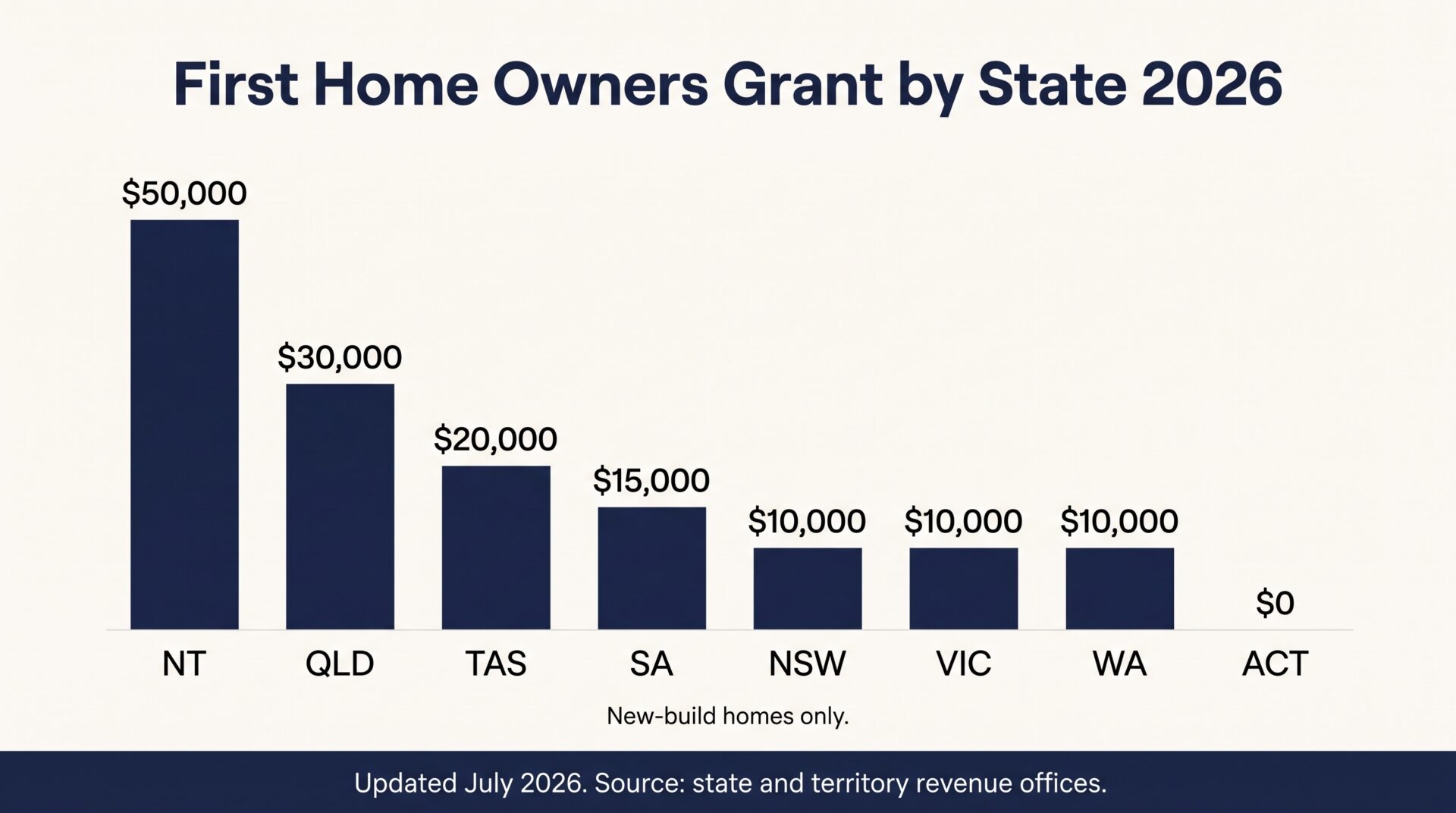
Here is the grant, side by side, for every state and territory as at July 2026. The property value cap applies to the grant itself. The paired duty relief is a separate measure with its own thresholds, covered in each state section further down.
| State / territory | Grant (2026) | New build only? | Grant property value cap | Paired stamp duty relief |
|---|---|---|---|---|
| Northern Territory | $50,000 | Yes | No cap | Stamp duty exemption on house-and-land |
| Queensland | $30,000 | Yes | Under $750,000 | Nil duty on a new first home, no cap |
| Tasmania | $20,000 | Yes | No cap | First home duty concessions |
| South Australia | $15,000 | Yes | No cap | Nil duty on a new home, no cap |
| New South Wales | $10,000 | Yes | $600,000 built / $750,000 land plus build | Nil duty to $800,000 |
| Victoria | $10,000 | Yes | $750,000 | Nil duty to $600,000 |
| Western Australia | $10,000 | Yes | $800,000 south / $1,000,000 north | Nil duty to $600,000 |
| Australian Capital Territory | No grant | n/a | n/a | Full duty exemption, no cap, no income test |
Grant amounts and caps are current as at July 2026 and are sourced from each state and territory revenue office. These figures move at state budgets, so confirm the current amount on the linked government page before you commit to a purchase. The Northern Territory figure is technically the HomeGrown Territory Grant, which replaced the older Territory First Home Owner Grant.
Which state has the biggest grant?
The Northern Territory pays the largest cash grant at $50,000 for a new home, well ahead of the field. Queensland is next at $30,000, then Tasmania at $20,000 and South Australia at $15,000. New South Wales, Victoria and Western Australia sit at the bottom of the cash table at $10,000 each. The ACT pays no grant at all.
A bigger grant does not automatically mean a better deal. The ACT hands out no cash, yet from 1 July 2026 its full stamp duty exemption can be worth more than a $10,000 grant on a typical purchase. When you are comparing states, always weigh the grant and the duty concession together rather than looking at the headline cash figure alone.
The new-build-only trap: why most grants skip established homes
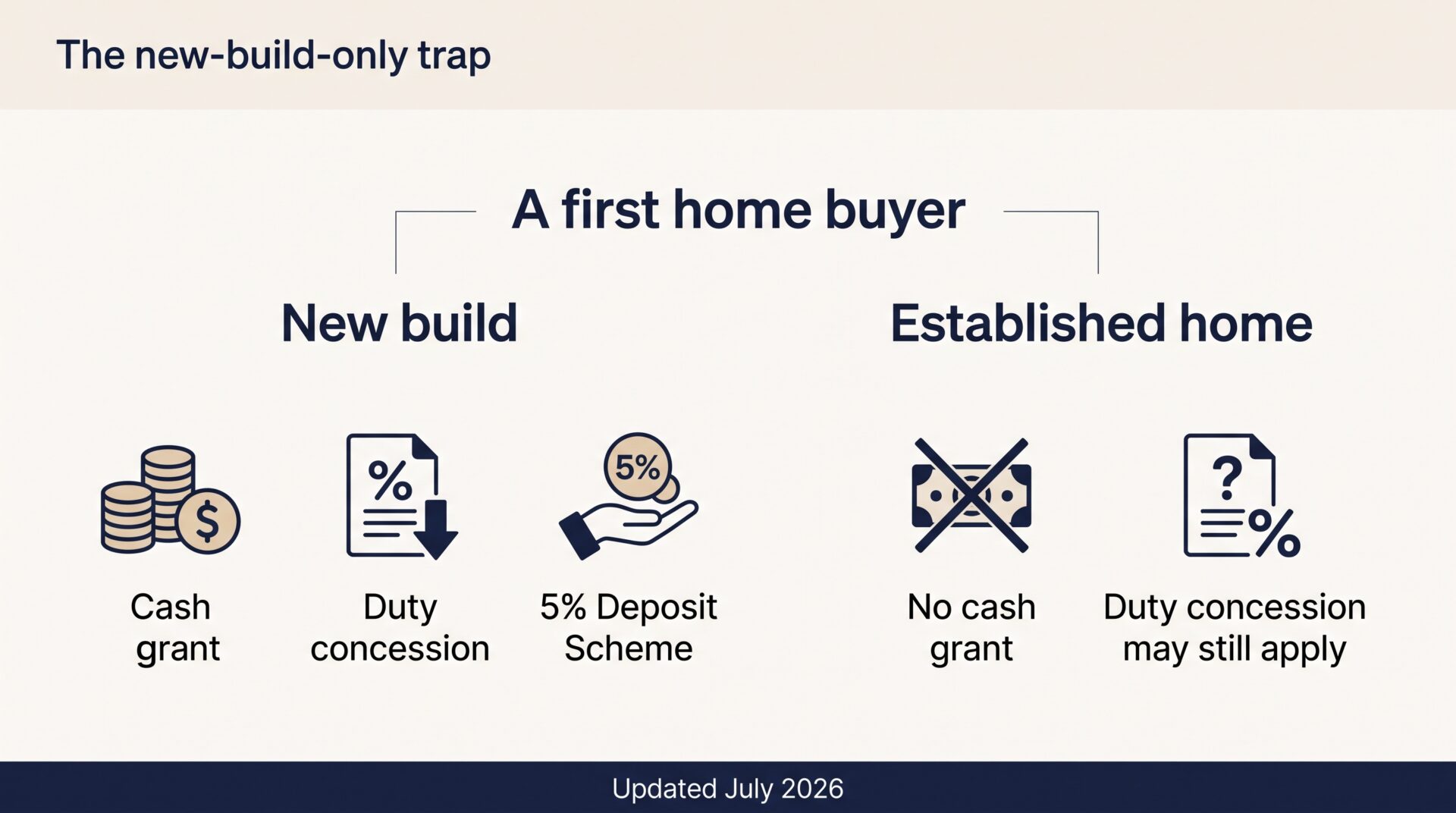
Here is the rule that trips up the most people. In every state and territory that still pays a grant, the first home owner grant applies only to a new home. That means a newly built house, an off-the-plan apartment, a house-and-land package, an owner-builder build or, in some states, a substantially renovated property that has not been lived in since the work was done. Buy an ordinary established home, the kind most first home buyers actually look at, and the cash grant is not available.
This is a real change from how the grant worked years ago, when it applied to established homes too. It is also why so many buyers arrive at their finance appointment expecting a grant they will never receive. In our experience, the honest conversation is often about matching the buyer to the right property type rather than the other way around. Sometimes the answer is that the grant only stacks up if you are willing to buy new.
The route for established-home buyers: the stamp duty concession
If you have your heart set on an established home, the grant is off the table, but you are not out of support. Almost every state offers a first home buyer stamp duty concession that does cover established homes, and on a typical first purchase the duty saving is often larger than the cash grant would have been. This is the practical route for most first home buyers.
The catch is that the grant and the duty concession are separate measures with different value caps in the same state, so it pays to check both. Our guide to the first home buyer stamp duty concession walks through how these concessions work, and our stamp duty by state comparison sets the thresholds side by side. You can also run your own numbers with our stamp duty calculator.
First home owners grant WA
The Western Australian first home owner grant is $10,000 for the purchase or construction of a new home. Let us clear up the most common myth first: there is no $40,000 grant in WA. The $40,000 figure circulates online and in conversation, but the actual grant is $10,000, and no income or assets test applies to it. Figures are current as at July 2026, sourced from the WA Department of Treasury and Finance.
WA applies a property value cap that splits along the 26th parallel of south latitude. For homes south of the parallel, which includes all of the Perth metropolitan area, the cap rose to $800,000 on 7 May 2026, up from $750,000. North of the parallel, the cap is $1,000,000. The grant covers new builds and substantially renovated homes only, not established homes.
On the duty side, WA runs a separate First Home Owner Rate of duty, and it was overhauled in the same 7 May 2026 package that lifted the grant cap. A first home buyer now pays no transfer duty on a home valued at or under $600,000, up from $500,000, with a concessional rate of $16.15 per $100 of excess applying from $600,001 to $800,000. The old split between the Perth and Peel regions and the rest of the state is gone — one set of rates now applies across WA. Vacant land is exempt to $450,000, up from $350,000, with a concession to $550,000. Just as importantly, the package severed the link between the grant cap and duty eligibility, so you can now claim a duty concession even where the purchase price sits above the grant cap. You can read the WA grant rules on the WA Government first home owner grant page. One thing worth checking if you bought recently: the duty changes needed legislation and system updates before they could be applied, so transactions entered into between 7 May 2026 and the commencement date were assessed at the old rates. Those can be reassessed afterwards and a refund issued. If you settled in WA during that window, it is worth asking RevenueWA or your settlement agent whether a refund is due.
First home owners grant SA
South Australia pays a first home owner grant of up to $15,000 for a new home, and it has one of the more generous settings in the country because there is no property value cap. For contracts signed on or after 6 June 2024, there is no limit on the value of the property you can claim the grant on. Figures are current as at July 2026, sourced from RevenueSA.
The grant covers a new home, an off-the-plan apartment, a substantially renovated home, a comprehensive building contract or an owner-builder build. It does not cover an established home, and it does not cover vacant land on its own until you have a building contract in place. The applicant and any partner must not have owned a home before, and you need to live in the property as your home for at least six continuous months within a year of settlement or completion.
South Australia backs the grant with matching stamp duty relief. Eligible first home buyers of a new home, an off-the-plan apartment or vacant land to build on pay no stamp duty, and, like the grant, that relief now carries no property value cap for qualifying contracts. Established homes are not eligible for this relief. See the RevenueSA first home owner grant page for the full rules.
First home owners grant VIC
The Victorian first home owner grant is $10,000 for a new home valued at $750,000 or less. The home must be newly built or never previously occupied, which includes off-the-plan purchases. Established homes do not qualify. Figures are current as at July 2026, sourced from the State Revenue Office Victoria.
One point worth clearing up: Victoria used to pay a larger $20,000 grant for regional new builds, and buyers still ask about it. That regional grant has ended, and there is now a single $10,000 grant across the whole state. If you see the $20,000 figure quoted, it is out of date.
Victoria pairs the grant with a strong duty concession that, unlike the grant, can apply to established homes as well as new ones. A first home buyer pays no duty on a home with a dutiable value up to $600,000, with a reduced rate applying between $600,001 and $750,000. That concession covers a new home, an established home or vacant land, which makes it the main lever for Victorian buyers looking at existing properties. The full rules are on the State Revenue Office Victoria first home owner grant page.
First home owners grant TAS
Tasmania pays a $20,000 first home owner grant for a new home, and this is the figure most likely to be quoted wrongly, so it is worth pinning down. For transactions that start between 1 July 2026 and 30 June 2027, the grant is $20,000. It sat at $30,000 during the boosted year to 30 June 2026, and that boost has now stepped down. If you read that the Tasmanian grant is $30,000, check the date, because as at July 2026 it is $20,000. Figures are sourced from the State Revenue Office Tasmania.
The grant applies to a new home only, including a kit home, an off-the-plan purchase or an owner-builder build, and there is no property value cap. The build generally needs to be completed within 24 months. Tasmania has also offered stamp duty relief to first home buyers, including a concession on established homes, but those settings are reviewed regularly and some have set end dates, so confirm the current duty position before you rely on it. You can check the grant rules on the State Revenue Office Tasmania first home owner page.
First home owners grant ACT
The ACT is the exception. It does not pay a first home owner grant. The territory stopped paying the grant on 1 July 2019, so if you are buying in Canberra, there is no cash grant to claim. Do not budget for one.
What the ACT offers instead is arguably the strongest first home duty support in the country. Through its Home Buyer Concession Scheme, and from 1 July 2026, eligible buyers pay no conveyance duty at all, with no property value cap and no income test. That exemption applies to any residential property, whether new, established or vacant land. For a first home buyer in the ACT, that full duty exemption often delivers a larger saving than a $10,000 cash grant would in another state. The details are on the ACT Revenue Office Home Buyer Concession Scheme page.
First home owners grant in QLD, NSW and NT
These three jurisdictions each have their own settings, and two of them anchor the top and bottom of the cash table.
Queensland pays a $30,000 first home owner grant for a new home valued under $750,000. The increased $30,000 amount continues for eligible contracts signed from 1 July 2026 onward, so it has not reverted to the older $15,000 figure. Queensland also offers a full first home concession that reduces transfer duty to nil on a new first home, with no value cap, for contracts dated on or after 1 May 2025. See the Queensland Government first home owner grant page.
New South Wales pays a $10,000 grant, but the caps are tight: the completed new home must be valued at $600,000 or less, or $750,000 or less where you are buying land and building. NSW backs this with the First Home Buyers Assistance Scheme, which gives a full transfer duty exemption on a home valued at $800,000 or less and a concessional rate up to $1,000,000, and that duty relief covers both new and established homes. Our article on the NSW stamp duty exemption covers who qualifies. See the Revenue NSW first home owner grant page for the grant itself.
The Northern Territory has the biggest support of all. It replaced its old $10,000 grant with the HomeGrown Territory Grant, which pays $50,000 to first home buyers building or buying a new home, with no cap on the purchase or build price, for contracts signed between 1 October 2024 and 30 September 2027. It covers off-the-plan purchases and owner-builders, and the Territory also offers a stamp duty exemption on house-and-land purchases. See the Northern Territory Government HomeGrown Territory page. All figures in this section are current as at July 2026, sourced from each jurisdiction’s revenue office.
FHOG versus the 5% Deposit Scheme: do not confuse them
This is the confusion we untangle most often. The first home owner grant and the federal 5% Deposit Scheme are completely different things, and mixing them up leads to real planning mistakes.
The first home owner grant is a state or territory measure. It is cash, it is paid once, and in almost every case it applies only to a new build. The amount depends on where you buy.
The Australian Government 5% Deposit Scheme, formerly the First Home Guarantee, is a federal measure. It is not cash. It is a guarantee that lets an eligible first home buyer purchase with a deposit as small as 5% while avoiding lenders mortgage insurance (LMI), the premium lenders normally charge when you borrow more than 80% of a property’s value. From 1 October 2025 the scheme has no income caps and no place limits. The official rules sit on the Australian Government’s 5% Deposit Scheme page, and our full explainer on the Australian Government 5% Deposit Scheme covers how it works for your loan.
The two measures stack. A single buyer can take a state cash grant, use the federal 5% Deposit Scheme to get in with a smaller deposit, and claim a state stamp duty concession, all on the same purchase. There are also two other federal measures worth naming so you do not confuse them either: the First Home Super Saver Scheme, which lets you save a deposit inside super, and Help to Buy, a federal shared-equity scheme where the government takes an ownership share. Each is separate from the grant.
Stacking it: grant plus 5% Deposit Scheme plus duty concession
The real value of a broker on these purchases is lining up every measure into one loan application. Here is how the pieces fit together in two states. The dollar figures below are illustrations only, not quotes, and eligibility rules apply.
Worked example: a new-build buyer in WA
Say you are buying a new home in the Perth metropolitan area for $600,000. Because it is a new build under the $800,000 WA cap, you qualify for the $10,000 grant. Using the 5% Deposit Scheme, you can buy with a 5% deposit of $30,000 and avoid LMI, rather than saving the roughly $120,000 you would need for a 20% deposit. On the duty side, $600,000 now sits right on the First Home Owner Rate threshold, so you pay no transfer duty at all. Before 7 May 2026 the same purchase fell into the concessional band above $500,000 and attracted a reduced but real duty bill.
Put together, that is a $10,000 cash grant toward your costs, a much smaller deposit, and a duty bill of zero, all on the one purchase. The grant can usually be applied at settlement, and your lender lodges it for you as an approved agent.
Worked example: a new-build buyer in SA
Now say you are buying an off-the-plan apartment in Adelaide for $650,000. In South Australia there is no value cap on either the grant or the new-home duty relief, so you claim the full $15,000 grant and pay no stamp duty at all. Add the 5% Deposit Scheme, and you buy with a $32,500 deposit and no LMI.
That combination, a $15,000 grant, a full duty exemption and a 5% deposit with no LMI, is one of the more powerful stacks available to a first home buyer anywhere in the country right now. In our experience, the 5% Deposit Scheme does more than shrink the deposit. Buyers who use it to buy at a high loan-to-value ratio, the share of the property’s value that you are borrowing, often keep a sharper interest rate than they would get on a standard high-deposit-gap loan, because the scheme protects the pricing. To see how a stack like this shapes your borrowing, try our borrowing power calculator.
How to claim the first home owners grant
The mechanics are similar across the country, with each revenue office running its own forms.
- Check you are eligible. You need to be a genuine first home buyer, buying a new home within any value cap that applies, and you must plan to live in it as your home for the required period.
- Apply through your lender. Most buyers lodge the grant through their bank or lender, who acts as an approved agent. This is usually the smoothest path, because it lets the grant be paid at settlement, or at the first drawdown if you are building.
- Or apply directly. You can instead apply straight to your state or territory revenue office after settlement or completion.
- Mind the deadline. You generally need to apply within 12 months of settlement or of the build being finished.
A word of caution from years of doing this. Government schemes have one-shot rules and eligibility traps that only surface once you dig in. The First Home Super Saver Scheme, for instance, can be used once only. We have seen a buyer plan a withdrawal around it, only to find their partner had already used the entitlement years earlier, which forced a full rethink of the deposit. Confirm every scheme you are counting on before you build a purchase plan around it.
Frequently asked questions
How much is the first home owners grant in each state? As at July 2026, the grant is $50,000 in the Northern Territory, $30,000 in Queensland, $20,000 in Tasmania, $15,000 in South Australia, and $10,000 in New South Wales, Victoria and Western Australia. The ACT pays no grant. Every grant applies to new builds only, and amounts change at state budgets, so confirm the current figure with the relevant revenue office.
Can you get the first home owners grant on an established home? No. In every state and territory, the grant now applies only to a new build, an off-the-plan purchase or a substantially renovated home. Buyers of an established home cannot claim the cash grant, but they may still qualify for a first home buyer stamp duty concession, and in most cases for the federal 5% Deposit Scheme.
Which state has the biggest first home owners grant? The Northern Territory has the largest grant at $50,000 for a new home, followed by Queensland at $30,000 and Tasmania at $20,000. South Australia pays $15,000, and New South Wales, Victoria and Western Australia each pay $10,000. Figures are current as at July 2026.
Does the ACT have a first home owners grant? No. The ACT stopped paying the grant on 1 July 2019. Instead it runs the Home Buyer Concession Scheme, and from 1 July 2026 that scheme offers a full stamp duty exemption with no property value cap and no income test, which for many buyers is worth more than a cash grant.
Is the first home owners grant taxed or income tested? The grant is not taxed, and most states apply no income test to the grant itself. Eligibility turns on being a genuine first home buyer, buying a new build under any applicable value cap, and living in the property as your home for a set period. Some paired duty concessions have their own separate rules.
Can you get the first home owners grant and the 5% Deposit Scheme together? Yes. The state grant and the federal 5% Deposit Scheme are different measures, and an eligible buyer can use both, often alongside a state stamp duty concession. The grant is a one-off cash payment for a new build; the 5% Deposit Scheme is a federal guarantee that lets you buy with a 5% deposit and avoid lenders mortgage insurance.
How do you apply for the first home owners grant? Most buyers apply through their lender, who lodges the grant as an approved agent so it can be paid at settlement or at the first construction drawdown. You can also apply directly to your state or territory revenue office after settlement. You generally need to apply within 12 months of settlement or completion.
Speak to a mortgage broker
The first home owner grant is rarely the whole story. The real gains come from lining up the grant, the stamp duty concession and the 5% Deposit Scheme into one clean application, and from matching all of that to a property type that actually qualifies. That is the work we do every week. With access to 52+ lenders, we can structure your purchase so every measure you are entitled to pulls its weight. If you are ready to map out your first purchase, talk to the team at Mortgage World Australia.
This article contains general information only and does not constitute financial advice. Your personal financial situation, objectives and needs have not been considered. Before acting on any information, you should consider its appropriateness to your circumstances. Speak to a qualified mortgage broker for advice tailored to your situation. Mortgage World Australia Pty Ltd is a credit representative (CR No. 396946) of Mortgage Specialists Pty Ltd (Australian Credit Licence No. 387025).

Patrick is a Director and a Home Loan Specialist. He has been helping Australians with home loans since 2001. Prior to working as a mortgage broker Patrick was employed by Macquarie Bank for 3 years and also worked as an accountant for a publicly listed company. Patrick’s qualifications include:
Bachelor of Business, UTS Sydney. Majored in accounting and sub-majored in Finance and Marketing.
Diploma of Finance and Mortgage Broking Management FNS50310
Certificate IV in Financial Services (Finance/Mortgage Broking) FNS40804
Ready to Take the Next Step?
Whether you’re looking to buy your first home, refinance, or explore investment opportunities, Mortgage World Australia is here to help.
Fill out the contact form below, and one of our expert mortgage brokers will be in touch shortly to discuss your needs and guide you through your options.
Get Started Today!