

How Long Does Home Loan Approval & Settlement Take?
How Long Does It Take From Application to Settlement?
On this page ▾
- The Home Loan Approval Timeline, Stage by Stage
- How Long Does Settlement Take?
- What Happens on Settlement Day (PEXA and Why It Can Move)
- What Delays Home Loan Approval, and How a Broker Pre-empts It
- What Causes Settlement Delays?
- How Long Does Settlement Take When Refinancing?
- How to Speed Up Your Approval and Settlement
- How a Mortgage Broker Keeps Your Timeline on Track
- Frequently Asked Questions
For a straightforward application with your documents ready, a home loan usually moves from application to unconditional approval in about one to two weeks, then to settlement over the following four to six weeks. So most buyers are in their new home within roughly six to eight weeks of applying. That is the typical picture, not a promise. The clock is really two clocks, the approval clock and the settlement clock, and each has its own delays. Since 2001 we have run this timeline across 52+ lenders, and the stage that catches people out is almost never the one they expect.
Here is the whole process at a glance. Every figure below is a typical range for a clean application, not a guarantee, and we explain what moves each one later in this guide.
| Stage | What happens | Typical time |
|---|---|---|
| Application and documents | You lodge the application with your income, ID and expense documents | A few hours to a few days to prepare |
| Conditional approval (pre-approval) | The lender assesses your borrowing capacity and pre-approves you | 1 to 5 business days |
| Property valuation | The lender values the property you are buying | 1 to 5 business days |
| Unconditional (full) approval | All conditions met, the loan is confirmed | A few days to about 2 weeks |
| Settlement period | The contract term between exchange and settlement | Around 4 to 6 weeks in NSW |
| Settlement day | Money and title change hands | About 30 to 60 minutes |
If you want the wider context around these stages, our guide to the process of buying a house walks through every step from offer to keys. This article zooms in on the timing.
The Home Loan Approval Timeline, Stage by Stage
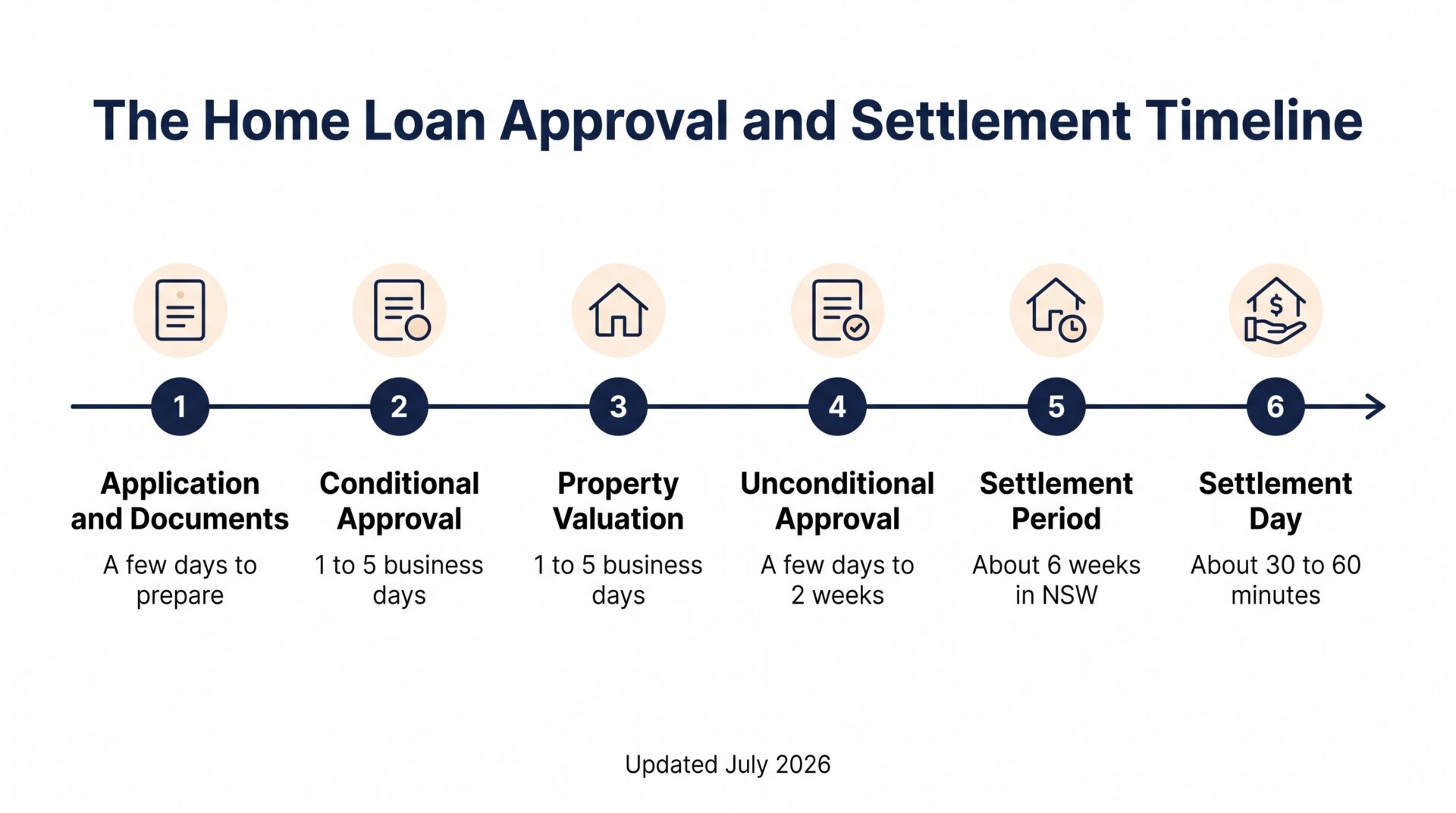
The approval clock covers everything the lender does before your loan is confirmed. It runs in four stages. Here is what each stage involves and how long it usually takes.
Step 1: Application and Documents
Nothing starts until your application is lodged with a complete document set. That means proof of income (payslips, or tax returns and financials if you are self-employed), identification, and a record of your living expenses and existing debts. The lender uses these to check serviceability, which is whether you can afford the repayments after buffers are applied.
The lodgement itself is quick. Preparing the documents is where buyers lose days. If a payslip is missing or a bank statement is out of date, the file stops until it arrives. Our home loan document checklist sets out exactly what to have ready, and it is worth knowing how much you can borrow before you apply so the numbers hold up under assessment. The Australian Government’s Moneysmart guide to applying for a home loan covers the same groundwork from the regulator’s side.
Step 2: Conditional Approval (Pre-Approval), 1 to 5 business days
Conditional approval, also called pre-approval or approval in principle, is the lender saying it will lend to you subject to conditions. The main condition is usually a satisfactory valuation of the property you end up buying. For a clean application, the majors often return conditional approval within one to three business days, though it can stretch to five or more when a lender is busy or the income is complex.
Pre-approval is not a full loan, but it tells you your budget and shows agents you are a serious buyer. It is usually valid for about 90 days: CommBank sets conditional pre-approval at 90 days, and ANZ says pre-approval generally lasts three months. Our guide to home loan pre-approval explains what it does and does not lock in. The key thing to remember is that a firm loan only exists once approval becomes unconditional.
Step 3: Property Valuation, 1 to 5 business days
Once you have a property, the lender orders a valuation to confirm the security is worth what you are paying. A desktop or automated valuation can come back the same day. A full inspection valuation, where a valuer physically attends, typically takes one to five business days depending on how quickly the valuer can access the property.
The valuation is the single most common surprise in the timeline. If it comes back lower than the purchase price, your loan-to-value ratio (LVR, the loan divided by the property value) rises, which can trigger lenders mortgage insurance or reduce the amount the lender will advance. We watch this stage closely because it can quietly reshape a whole application.
Step 4: Unconditional (Full) Approval, a few days to about 2 weeks
Unconditional approval, sometimes called formal or full approval, means every condition has been met and the loan is confirmed. With the valuation in and the file clean, some lenders confirm within one to three days: ANZ, for example, quotes a full approval response of one to three days, while CommBank notes many applications take up to four to seven business days to assess. Where there is a hurdle, such as lenders mortgage insurer sign-off above 80% LVR or a document the assessor wants clarified, it can take up to about two weeks.
Once you are unconditional, the lender prepares your loan documents. You sign and return them, and the file moves from the approval clock to the settlement clock.
How Long Does Settlement Take?
Settlement is the day ownership legally transfers and the money is paid. The time between exchanging contracts and that day is the settlement period, and it is set in the contract of sale. Across Australia it usually runs 30 to 90 days. In New South Wales the convention is around six weeks, which is 42 days.
Typical Settlement Periods by State
Settlement periods are conventions, not fixed rules. The seller proposes a date in the contract and the parties can negotiate it. The table below shows the typical range in each state and territory.
| State or Territory | Typical settlement period |
|---|---|
| NSW | Around 6 weeks (42 days) |
| VIC | 30 to 90 days |
| QLD | 30 days is common, often negotiated to 30 to 60 |
| SA | Around 30 days, 30 to 60 in practice |
| WA | A minimum of about 6 weeks |
| TAS | 30 to 90 days |
| ACT | Around 30 days |
| NT | 30 to 90 days |
In NSW, the government confirms that settlement usually takes place around six weeks after contracts are exchanged, and that you also have a five business day cooling-off period after exchange (ten business days for off-the-plan purchases). In Victoria, Consumer Affairs Victoria notes the settlement period is usually 30 to 90 days and is set by the seller in the contract.
Settlement Period vs Settlement Day
This is the distinction that trips up most buyers, and it is worth being precise about. The settlement period is the multi-week stretch written into the contract, the four to six weeks in NSW during which your conveyancer, the seller’s conveyancer and both lenders get everything ready. Settlement day is the single day at the end of that period when the transfer actually happens, and the transfer itself takes minutes, not weeks. When someone searches for how long settlement takes on the day, they are asking about that final short transfer, not the six-week period leading up to it.
What Happens on Settlement Day (PEXA and Why It Can Move)

Most settlements in Australia now happen electronically through PEXA, the online platform where conveyancers and lenders complete the transfer. Once both sides mark their workspace ready at the scheduled time, the transfer usually completes within 30 to 60 minutes. Your conveyancer or solicitor typically calls to confirm shortly after, and that is when you can collect the keys.
Money can take a little longer to land than the transfer suggests. Sale proceeds often reach the seller the same day, but banks can take up to three business days to fully clear funds, especially when money moves between different institutions. Settlement can also move on the day if one party is not ready, if funds have not arrived, or if the seller’s mortgage discharge is not finalised. Your conveyancer manages this process, and our guide to the role of your conveyancer explains who does what on the day.
What Delays Home Loan Approval, and How a Broker Pre-empts It
Most approval delays come from a handful of predictable issues. Knowing them in advance is how we keep a file moving.
- Valuation surprises. A low valuation raises your LVR and can trigger lenders mortgage insurance. We check the likely valuation before choosing a lender, because valuers and lender panels differ.
- Missing or stale documents. An out-of-date payslip or bank statement stops the assessment cold. We collect a complete set up front.
- Serviceability and existing debts. Lenders assess repayments with a buffer on top of the actual rate, and a high card limit or car loan can reduce your capacity. Understanding how much you can borrow before you apply avoids a decline.
- Employment changes. This one catches people out. In our experience, starting a new job right before you buy can stall an approval for weeks, because most lenders want to see a payslip from the new role before they will approve. We have seen this push a timeline out by around six weeks. The fix is knowing which lenders are flexible: a handful, NAB among them, will accept a signed employment contract instead of waiting for that first payslip. It is worth knowing before you hand in your notice.
- Lenders mortgage insurer sign-off. Above 80% LVR the loan usually needs the LMI insurer’s approval as well as the lender’s, which adds a step.
A broker’s job is to spot these before the file is lodged, not after it stalls. We match you to a lender whose policy and turnaround actually fit your situation, which is often the difference between a two-week approval and a two-month one.
What Causes Settlement Delays?
Once you are unconditional, settlement usually runs to schedule, but a few things can push it back. The most common are the seller’s mortgage discharge not being ready in time, conveyancing searches taking longer than expected, loan documents being signed and returned late, or an issue found at the final inspection. Occasionally the buyer’s funds do not clear in time on the day.
If settlement is delayed, the contract usually allows penalty interest to be charged for each day of delay, and in some cases a notice to complete can be issued. This is why staying in close contact with your conveyancer through the settlement period matters, so nothing is left to the last day.
How Long Does Settlement Take When Refinancing?
Refinancing has its own, usually shorter, clock because there is no purchase contract and no vendor. Once your new loan is unconditionally approved and documents are signed, settlement is typically arranged within about one to three weeks. The new lender pays out and discharges your old loan, and the security is transferred between lenders, again usually through PEXA.
The most common hold-up on a refinance is the discharge itself. Your existing lender has to complete a discharge authority, and some are slower than others. Lodging the discharge request early is the surest way to keep a refinance on track.
How to Speed Up Your Approval and Settlement
You cannot control a lender’s queue, but you can control most of what sits in front of it. These steps consistently shave time off the timeline.
- Get pre-approved before you shop. It confirms your budget and means the only condition left is the valuation.
- Have every document ready on day one. Use a document checklist so nothing is missing at lodgement.
- Respond to lender requests the same day. Assessors work in queues, and a slow reply sends your file to the back.
- Choose a lender whose turnaround suits your deadline. Some lenders assess a clean file in a couple of business days; others take one to two weeks when volumes are high.
- Line up your conveyancer early. Booking them at offer stage, not after exchange, keeps the settlement clock moving.
- Avoid major changes mid-application. Do not change jobs, take on new debt, or make large purchases until the loan is settled.
How a Mortgage Broker Keeps Your Timeline on Track
The approval clock and the settlement clock are managed by different people, the lender on one side and your conveyancer on the other. A broker sits across both. Under our Best Interests Duty, we compare 52+ lenders and match you to one whose policy, valuation panel and turnaround fit your circumstances, then watch the file from application through to settlement rather than only at the start.
That end-to-end view is where the timeline is won or lost. For a client selling one home and buying another, for example, we almost always recommend a pre-approval conditional on the sale before listing, then a longer settlement of around twelve weeks on the purchase, so there is time to find the next place without gambling. Getting the structure right at the start prevents most of the delays that show up later. Using a broker also costs you nothing directly, because the lender pays the broker a commission, a point the Moneysmart guide to using a mortgage broker explains in plain terms.
If you want a realistic timeline for your own purchase, talk to a mortgage broker at Mortgage World Australia. We will map the approval and settlement clocks to your situation and flag anything likely to slow either one down.
Frequently Asked Questions
How long does the whole home loan process take, start to settlement?
For a straightforward application with your documents ready, most buyers move from application to unconditional approval in about one to two weeks, then to settlement over the following four to six weeks. That puts you in your new home roughly six to eight weeks after you apply. Complex income, a slow valuation or a delayed vendor discharge can stretch this out.
How long does settlement take in Australia?
The settlement period is set in the contract of sale and usually runs 30 to 90 days. In New South Wales the convention is around six weeks, which is 42 days after contracts are exchanged. Victoria is typically 30 to 90 days, and Western Australia is a minimum of about six weeks. The parties can negotiate a shorter or longer period.
How long does settlement take on the day?
With PEXA electronic settlement, the transfer itself usually completes within 30 to 60 minutes once both sides are ready at the scheduled time. Your conveyancer or solicitor typically calls to confirm shortly after. Sale proceeds often reach the seller the same day, though banks can take up to three business days to fully clear funds.
What is the difference between conditional and unconditional approval?
Conditional approval, also called pre-approval or approval in principle, means the lender will lend subject to conditions, such as a satisfactory property valuation. Unconditional approval, or formal approval, means every condition has been met and the loan is confirmed. You only have a firm loan once approval is unconditional.
How long is pre-approval valid for?
Conditional pre-approval is usually valid for about 90 days, or three months, with the major banks. If you have not found a property by then, it can generally be renewed, provided your income, expenses and circumstances have not changed.
What happens if I cannot settle on the agreed date?
If you cannot settle on the agreed date, the contract usually allows the other party to charge penalty interest for each day of delay, and in some cases to issue a notice to complete. The cause is often a late valuation, funds not clearing, or the seller’s mortgage discharge not being ready. Keeping your broker and conveyancer in close contact is the surest way to avoid it.
Patrick O’Brien, Director and Home Loan Specialist since 2001.
This article contains general information only and does not constitute financial advice. Your personal financial situation, objectives and needs have not been considered. Before acting on any information, you should consider its appropriateness to your circumstances. Speak to a qualified mortgage broker for advice tailored to your situation. Mortgage World Australia Pty Ltd is a credit representative (CR No. 396946) of Mortgage Specialists Pty Ltd (ACN 612 422 178, Australian Credit Licence No. 387025).

Patrick is a Director and a Home Loan Specialist. He has been helping Australians with home loans since 2001. Prior to working as a mortgage broker Patrick was employed by Macquarie Bank for 3 years and also worked as an accountant for a publicly listed company. Patrick’s qualifications include:
Bachelor of Business, UTS Sydney. Majored in accounting and sub-majored in Finance and Marketing.
Diploma of Finance and Mortgage Broking Management FNS50310
Certificate IV in Financial Services (Finance/Mortgage Broking) FNS40804
Ready to Take the Next Step?
Whether you’re looking to buy your first home, refinance, or explore investment opportunities, Mortgage World Australia is here to help.
Fill out the contact form below, and one of our expert mortgage brokers will be in touch shortly to discuss your needs and guide you through your options.
Get Started Today!