
Using super to buy a house: your options explained
Using super to buy a house: your options explained
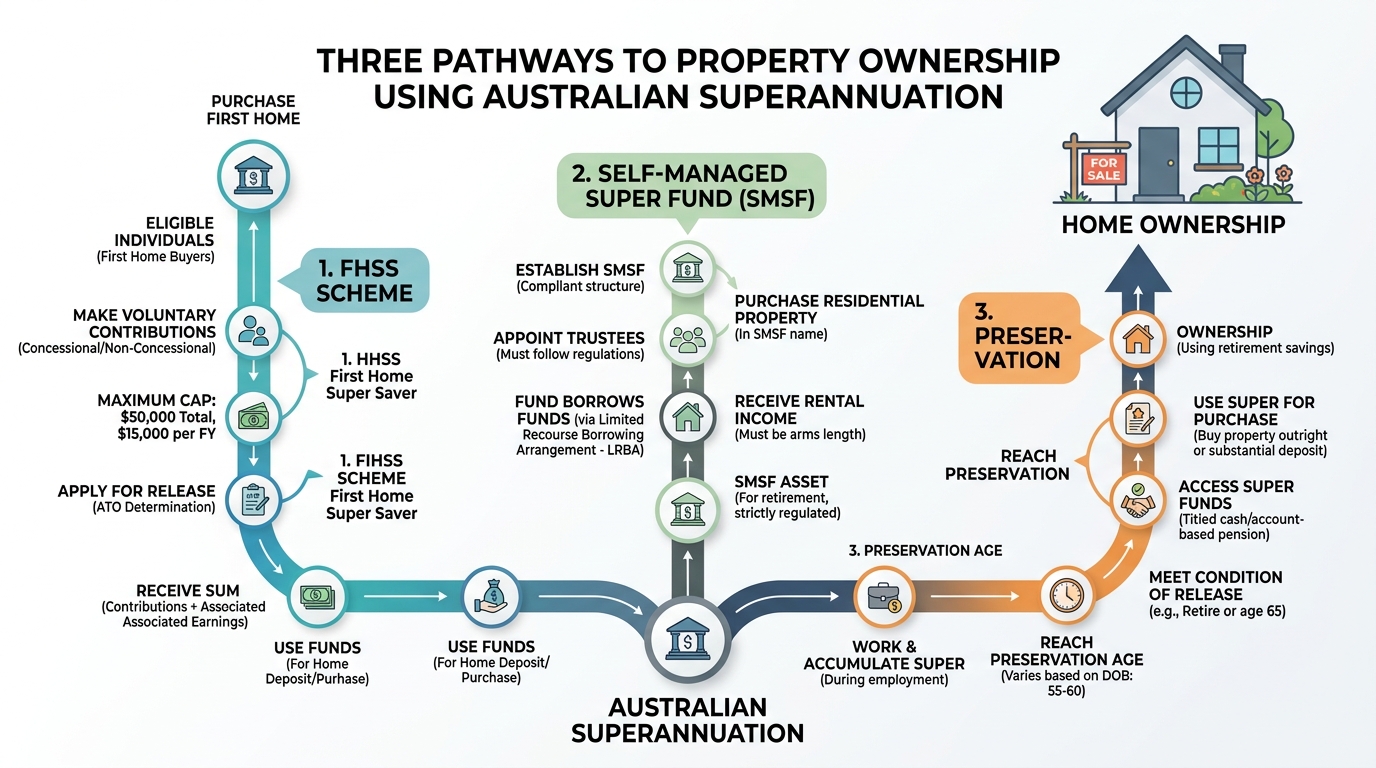
Superannuation is designed for retirement. But there are three legitimate pathways that allow you to use super — or the tax advantages that come with super contributions — to buy property in Australia. Two work before retirement. One doesn’t.The rules are different for each, and the details matter. Get them wrong and you’ll lose access to funds, cop a 20% tax hit, or find yourself locked into a property you can’t easily exit. This guide covers how each option works, who qualifies, and what you’re actually signing up for when you go down any of these routes.Can you use super to buy a house?
On this page ▾
The three ways super can help you buy property
| Pathway | Who it’s for | Can you live in it? | Access before preservation age? |
|---|---|---|---|
| FHSS scheme | First home buyers | Yes | Yes |
| SMSF | Investors with sufficient super | No (investment only) | Yes (via SMSF structure) |
| Preservation age access | Anyone aged 60+ in retirement | Yes | Not applicable |
Option 1: The First Home Super Saver (FHSS) scheme
The FHSS scheme is the most accessible option. It’s designed specifically for first home buyers who want to use the tax advantages inside superannuation to save a house deposit faster.Here’s how it works. You make voluntary contributions to your super fund on top of your regular employer contributions. Those voluntary contributions receive concessional tax treatment inside super. When you’re ready to buy, you apply to the ATO to release those contributions — plus associated earnings — as a house deposit.The tax advantage is real. Concessional (before-tax) contributions to super are taxed at 15%, compared to your marginal income tax rate, which may be 32.5%, 37%, or 45%. That gap means your deposit grows faster inside super than it would sitting in a standard savings account. If you’re on a 37% marginal rate and salary-sacrifice $15,000 per year into super instead of saving it in a bank account, you’re looking at around $3,300 in tax savings per year before investment returns even kick in.Who is eligible for the FHSS scheme?
To use the FHSS scheme, you must:- Be 18 years or older at the time of applying for a release determination
- Have never owned real property in Australia — residential, commercial, or rural
- Have never previously requested a release of funds under the FHSS scheme
- Intend to genuinely live in the property you’re purchasing for at least 6 months within the first 12 months after you’re entitled to occupy it
How much can you save through the FHSS?
- Annual contribution limit: $15,000 per financial year in eligible voluntary contributions
- Lifetime cap: $50,000 per person across all contributing years
- What gets released: Your voluntary contributions plus associated earnings. The ATO calculates earnings using a set formula (the shortfall interest charge rate plus 3%), not the actual returns your super fund achieved.
Step-by-step: how to apply for the FHSS
- Make voluntary contributions to your super fund — either concessional (salary sacrifice or personal deductible contributions) or non-concessional (after-tax personal contributions). You can contribute up to $15,000 per financial year under the FHSS scheme.
- Check your FHSS eligible balance through the ATO’s online services in myGov. This confirms how much you can apply to release.
- Apply for an FHSS determination from the ATO via myGov. As of 15 September 2024, this determination must be in hand before you sign any property contract. The ATO issues a determination confirming the maximum releasable amount.
- Sign a contract to purchase or construct a home. The determination must already be obtained at this point.
- Apply to release your FHSS funds through the ATO within 14 days of signing the contract. The ATO instructs your super fund to release the amount to the ATO, which deducts withholding tax and pays you the balance.
Option 2: Buying investment property through an SMSF
A self-managed super fund (SMSF) is a private super fund you control as trustee. Unlike the FHSS scheme, SMSF property investment is not limited to first home buyers — but it is significantly more complex. You’re acquiring an investment property inside a legal structure that must comply with superannuation law and ATO regulations at every step.The fundamental rule: property purchased inside an SMSF must serve the retirement interests of the fund members. You cannot buy a property to live in. You cannot use it for personal benefit while it’s held in the fund. This is known as the sole purpose test.In practice, this restriction disqualifies a lot of properties and structures that seem innocent. If you’re thinking “I’ll buy the investment property now, then move into it later,” or “I’ll purchase my family’s existing property and pay the SMSF rent to live in it” — stop. The ATO actively audits SMSF property transactions for these kinds of breaches, and penalties are steep.What an SMSF can — and cannot — buy
An SMSF can purchase: – Residential investment property (rented to unrelated tenants at market rate) – Commercial property (and uniquely, commercial property can be purchased from a related party and rented back to a related party’s business at market rates) – Rural or industrial propertyAn SMSF cannot purchase: – A property you or any related party lives in (the residential related-party rule — commercial is the exception) – A residential property purchased from a related party – A holiday home used by members or associatesThe related-party restriction catches a lot of people off guard. You cannot buy the property from a family member. You cannot rent it to your adult children. You cannot purchase your own home and transfer it to your SMSF. The ATO actively audits SMSF property transactions for related-party breaches, and penalties for non-compliance are severe.For a detailed breakdown of the rules and compliance requirements, see our guide to SMSF property rules after 10 August 2026.How SMSF borrowing works (limited recourse borrowing)
If your SMSF doesn’t have enough cash to purchase property outright, it can borrow — but only through a limited recourse borrowing arrangement (LRBA). This structure is specific to super funds and works differently from a standard investment loan.Here’s what’s happening behind the scenes. The SMSF trustee enters a loan agreement with a lender. A separate bare trust is then established. The bare trustee holds legal title to the property while the loan remains outstanding — the SMSF holds the beneficial interest. If the fund defaults, the lender’s claim is limited to the property in the bare trust — not the other assets of the SMSF. That’s the “limited recourse” element. Once the loan is repaid in full, legal title transfers from the bare trust to the SMSF trustee directly.This structure exists because superannuation law generally prohibits super funds from pledging their assets as security for borrowings. The LRBA is the legislated exception.Now, here’s the constraint you need to know about: the SMSF loan market is narrow. Approximately 10 lenders in Australia currently offer LRBA-structured SMSF loans. Interest rates are typically higher than standard investment loans, and maximum LVRs are usually 70–80% for residential property (some specialist lenders offer up to 90% in specific circumstances, though the standard market sits in that range). Each lender has different criteria: minimum fund balances, property value thresholds, LVR limits, and acceptable property types. Some won’t lend on apartments below a certain size. Others restrict lending by state or postcode. Without access to the full market, you can easily end up with the wrong lender — or no approval at all.Our SMSF lending guide covers what the specialist lenders we work with will still finance after 10 August 2026.SMSF property: benefits and risks
Benefits: – Rental income inside the SMSF is taxed at 15% in the accumulation phase — significantly lower than most investors’ marginal rates – Capital gains are effectively taxed at 10% if the property is held for more than 12 months (the standard 15% rate with a one-third CGT discount applied) – In pension phase, rental income and capital gains can be entirely tax-free – Full control over investment decisions within the SMSF – Commercial property purchased by the SMSF can be leased to your own business — a structure that combines property ownership and business occupancy in a tax-advantaged structureRisks: – Compliance obligations are ongoing and non-negotiable: annual audits, ATO reporting, trustee duties, fund investment strategy documentation – Property is illiquid — you cannot easily sell part of a property if the fund needs cash for member benefit payments or other expenses – Concentration risk is real. A single property can represent the majority of a fund’s total assets – Setup and ongoing costs add up: SMSF establishment, bare trust deed, LRBA documentation, annual audit fees, accounting, and potentially financial advice – Most advisers suggest a minimum fund balance of $200,000–$250,000 before SMSF property is cost-effectiveIf you’re considering this route, our detailed guide to investing in property through SMSF and the SMSF guide cover the strategy and compliance requirements in depth.Option 3: Accessing your super at preservation age
Your superannuation is “preserved” — which means you cannot simply withdraw it whenever you want. The law sets a minimum age, called the preservation age, before you can access super.When can you access super without restrictions?
For Australians born after 30 June 1964, preservation age is 60. Once you reach 60 and retire (or cease an employment arrangement), you can access your super as a lump sum or income stream with no tax on withdrawals from a taxed super fund.Before retiring, a Transition to Retirement (TTR) income stream is available from preservation age, but withdrawals are capped and lump sums are not permitted from a TTR pension while still working.Using your super at preservation age to buy a home is straightforward in principle: you withdraw funds and purchase a property. But it comes with real considerations:- Depleting your super balance leaves less for living expenses in retirement. A property you live in produces no rental income — unlike an investment property, it doesn’t replace the income-generating role your super was meant to play.
- Tax on withdrawal depends on your fund’s components. Funds may have a tax-free and taxable component depending on contribution history. For most people over 60 accessing a taxed fund, withdrawals are tax-free.
- You can live in the property. Unlike SMSF property, there’s no sole purpose test restriction once funds are withdrawn. The money is yours.
Comparing the three options
| FHSS Scheme | SMSF Property | Preservation Age Access | |
|---|---|---|---|
| Who it suits | First home buyers | Investors with $200k+ in super | Retirees aged 60+ |
| Can you live in it? | Yes | No | Yes |
| Maximum amount | $50,000 per person | No cap (fund balance + borrowing) | Entire super balance |
| Tax on rental income | Not applicable | 15% accumulation / 0% pension phase | Not applicable (withdrawn) |
| CGT treatment | Not applicable | 10% if held 12+ months | Not applicable |
| Complexity | Low–moderate | High | Low |
| ATO approval required | Yes (determination + release) | No (but strict ongoing compliance) | Yes (fund release) |
| Best for | Faster deposit accumulation | Long-term investment property strategy | Retirement home purchase |
Is using super to buy property worth it?
For the FHSS scheme, the answer is generally yes for eligible first home buyers. The tax savings are quantifiable. A buyer on a 37% marginal rate who salary-sacrifices $15,000 per year into super saves approximately $3,300 in tax compared to saving the same amount in a bank account — before investment returns. Over two or three years of consistent contributions, that’s a real difference to your deposit.For SMSF property, the answer depends heavily on your situation. The tax benefits are genuine: 15% tax on rental income versus 37% or 45% at the margin is material. But compliance costs, the complexity of LRBA lending, and the illiquidity of property in a super fund mean SMSF property is not the right tool for everyone.One alternative worth considering: if you’re a first home buyer who hasn’t had time to build up FHSS contributions, the first home guarantee scheme lets you buy with a 5% deposit and no Lenders Mortgage Insurance. You can potentially combine the First Home Guarantee with a smaller FHSS withdrawal — using whatever voluntary contributions you have accumulated — to maximise your deposit.How a mortgage broker can help
 For the FHSS scheme, your main interactions are with the ATO and your super fund. Where a mortgage broker adds value is on the home loan itself — making sure you maximise your borrowing capacity and access the most competitive rates across a wide lender panel.For SMSF lending, the broker’s role is more significant. The SMSF loan market is narrow. Around 10 lenders in Australia currently offer LRBA-structured loans, and each has different criteria: minimum fund balances, property value thresholds, LVR limits, and acceptable property types. Some won’t lend on apartments below a certain size. Others restrict lending by state or postcode. Without knowledge of who lends what and under what conditions, you’re navigating a specialist market without a map.Mortgage World Australia has access to 52+ lenders, including the specialist SMSF lenders. We can assess which lenders are most likely to approve your fund’s application — based on your fund balance, property type, location, and trustee structure — before a single application is lodged. That matters, because every application lodged creates a hard enquiry on your credit file — and multiple inquiries in a short period can lower your credit score.We also work across first home buyer loans for buyers combining an FHSS withdrawal with a standard home loan. If the FHSS covers part of your deposit, we structure the home loan to make the most of the remaining borrowing capacity across the 52+ lenders we work with.Ready to assess your options? Speak to a mortgage broker at Mortgage World Australia — we can assess whether the FHSS, SMSF lending, or a different strategy is the right fit for your situation. Appointments are available by phone or video.
Frequently asked questions
Can I use my super to buy a house before retirement?Yes, but only under specific conditions. First home buyers can use the First Home Super Saver (FHSS) scheme to withdraw voluntary super contributions — up to $50,000 per person — to use as a house deposit. Outside of this scheme, you cannot access your super before reaching preservation age (60 for most Australians born after 30 June 1964).Can I use my super for a house deposit in Australia?Yes, via the FHSS scheme. You make voluntary contributions to your super fund of up to $15,000 per financial year, then apply to the ATO to withdraw up to $50,000 (plus associated earnings) as a house deposit. The tax concessions inside super mean those contributions accumulate faster than they would in a standard savings account.Can I still get $10,000 out of my super?No. The COVID-19 early super release scheme — which allowed eligible Australians to withdraw up to $10,000 in the 2019-20 financial year, and a further $10,000 in 2020-21 — permanently closed on 31 December 2020. There is no equivalent scheme currently available.Is it worth buying property with super?It depends on the pathway and your circumstances. The FHSS scheme is generally worthwhile for first home buyers who can make consistent voluntary contributions over 2–3 years — the tax savings are real and quantifiable. SMSF property investment suits experienced investors with substantial fund balances and the discipline to manage compliance obligations. Using super at preservation age suits retirees with specific housing needs. A mortgage broker can assess the finance side; a financial adviser should assess the super strategy.How many lenders offer SMSF loans in Australia?Approximately 10 lenders currently offer SMSF loans structured as limited recourse borrowing arrangements (LRBAs). That’s a narrow market. Mortgage World Australia has access to 52+ lenders, including the specialist SMSF lenders, and can identify the right option for your fund’s structure, property type, and location.Patrick O’Brien, Director and Home Loan Specialist since 2001 — Mortgage World AustraliaDisclaimer: This article provides general information only and does not constitute financial, tax, or legal advice. Superannuation and tax laws are subject to change — the information in this article is current as of April 2026 but may be affected by upcoming legislation or ATO rulings. Always seek independent financial advice from a licensed financial adviser and tax advice from a registered tax agent for your specific situation. The Australian Taxation Office (ato.gov.au) is the authoritative source for superannuation rules. Mortgage World Australia has access to 52+ lenders. Credit criteria, fees, terms and conditions apply.

Patrick is a Director and a Home Loan Specialist. He has been helping Australians with home loans since 2001. Prior to working as a mortgage broker Patrick was employed by Macquarie Bank for 3 years and also worked as an accountant for a publicly listed company. Patrick’s qualifications include:
Bachelor of Business, UTS Sydney. Majored in accounting and sub-majored in Finance and Marketing.
Diploma of Finance and Mortgage Broking Management FNS50310
Certificate IV in Financial Services (Finance/Mortgage Broking) FNS40804
Ready to Take the Next Step?
Whether you’re looking to buy your first home, refinance, or explore investment opportunities, Mortgage World Australia is here to help.
Fill out the contact form below, and one of our expert mortgage brokers will be in touch shortly to discuss your needs and guide you through your options.
Get Started Today!